
For all media enquiries please contact Tsepang Molefe by phone on +27 33 342 5662 or +27 74 405 1257, or WhatsApp (+27 74 405 1257), or click here to send an e-mail. Click here to access our News and Press Release ARCHIVES menu at the page bottom.
groundWork 2021 Highlights
17 December 2021 - What a year! Yes, we always say this in groundWork, and we always promise that the next year is going to be less hectic, but the reality is we are activists, and this is how we roll. On adrenalin. Ok, I am getting old, and moving slower and more of a manager these days than an activist. But it is exciting to hear about all the work every Monday morning in our staff gathering and to be able to guide and with activists, shape struggle. I sometimes feel as if I am an intruder, because there is so much happening and keeping on top of all – is nigh impossible. From 3 we are now more than 20 with support associates. To make this growth happen in a coherent manner we have developed our five-year strategy from 2022 to 2026; we have had a great evaluation highlighting the strength of groundWork – and yes, some areas that need strengthening; and we are in the middle of a change process to better understand and manage our growth.
It is exciting to be part of local struggles in South Africa and across the continent. I live vicariously through the actions of all staff – and I wish I could be with of you every day. What an honour to lead such a great team. Sadly, we bid farewell to Luqman, who put our hospital work on the map in South Africa and Africa, but Mafoko and Azeeza have joined us to lead the Environmental Health Campaigns. And yes, we had to increase management in groundWork, and stepping up to the challenge was Rico. Thanks for taking on this challenge. And a big shout out to our young cohort of Nerissa, Asiphile, Mary-Joy (MJ) and Vuyi. Keep us rocking.
Finally, to all other staff not mentioned by name, we (Gill and I) love you all, to the Board, and especially the community organisations and people across South Africa and Africa who put their trust, faith and hope in us as we struggle with them – thanks for all your support. To our NGO partners – the Centre for Environmental Rights, Earthlife Africa, the Public Health Association of South Africa, Friends of the Earth International and Africa, Global Alliance for Incinerator Alternatives Oilwatch, Health Care Without Harm, Naledi, Support Centre for Land Change, Environmental and Rural Solutions – thanks for working with us. To all our funders – for supporting us, and for challenging us along the way.
A Luta Continua
Bobby Peek
Job Advertisement: Senior Coal Campaign Manager - The Groundwork Trust (groundWork, Friends of the Earth, South Africa)
Closing date: Monday, 17 January 2022
groundWork is an environmental justice organisation working with democratic fenceline formations to resist dirty energy and toxic production, build local alliances with workers for a just transition and advocate for open democracy. It was formed in 1999 to support people’s struggles for environmental justice, starting with people living on the fencelines of petrochemicals industries and waste facilities. It is a principles-driven NGO with committed and capable staff making a significant contribution towards building the environmental justice movement in South Africa and on the continent, and to holding government and companies accountable. groundWork works through the lens of just transition and open democracy.
groundWork works with a broad spectrum of people, ranging from NGOs, community organisations and peoples’ movements to governments and administrators (mainly in the health sector), primarily in South Africa but also across the continent. groundWork works with people who are challenging environmental racism and injustice on the ground and who are fighting for democratic control over resources such as energy and waste, for their Constitutional right to ‘an environment that is not harmful to their health and well-being’, and for their livelihoods.
groundWork achieves the objective of environmental justice through six campaigns:
1) Climate and Energy Justice; 2) Coal; 3) Waste; 4) Environmental Health; 5) Communications; and 6) Environmental Justice Education.
This is a call for a Senior Coal Campaigner to manage the groundWork Coal Campaign, to be based out of Johannesburg. groundWork is an equal opportunities employer.
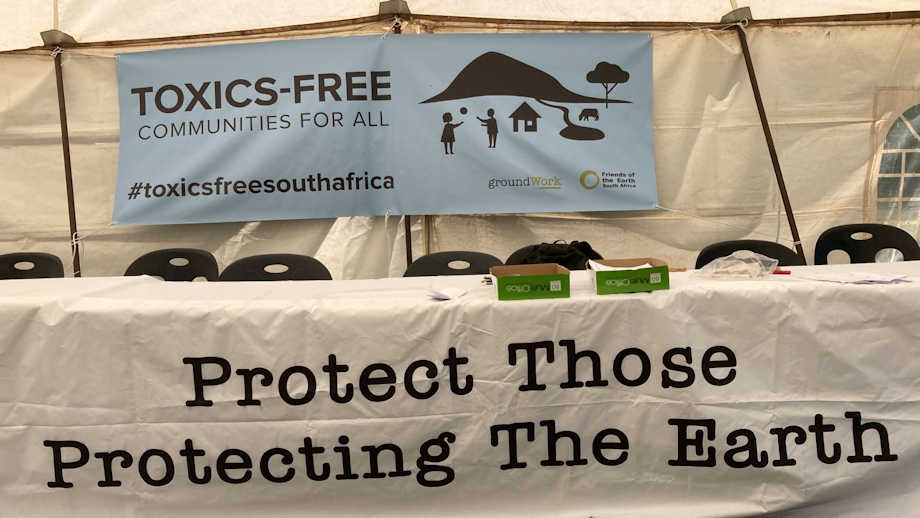
Civil Society Statement: National Exchange on Struggles against Hazardous Waste in South Africa
15 December 2021 - Representatives of civil society in Gauteng, the Free State, Eastern Cape and KZN gathered in solidarity on the 01 and 02 December 2021 in Durban, to call for a drastic reduction in the production and storage of toxic waste in South Africa, and to halt the import and export of toxic waste into our country.
The NGOs work with affected communities, and gathered to share, understand, and find equitable solutions to our common fight for the right to live in an environment that does not compromise our health and well-being . We believe that our people are entitled to environmental justice.
Poorly managed industries and toxic dumpsites throughout South Africa, that produce or handle highly hazardous material, are emitting toxic air pollution which cause chronic health complications for the affected communities.
Statement from the 7th Peoples Gathering to Resist Gas Expansion and Focus on Food held on 1st November 2021, Johannesburg.
10 December 2021- We have successfully challenged the expansion of the gas industry in South Africa. The stakes are higher as government pushes gas as a false solution to our energy requirements and in addressing the climate challenge in the just transition to a more sustainable and equal society for all. We, the communities, from KwaZulu-Natal, Western Cape, Eastern Cape, Northern Cape, Free State and Gauteng gathered in Johannesburg, on 1st November 2021 to reaffirm our commitment to fight for climate justice and a just transition and to call for an URGENT STOP to all future fossil fuel exploration and expansion, and managed phase out of fossil fuel to secure a just transition for all South Africans, and not only for the elite.
Tribute to the life of Oupa Lehulere
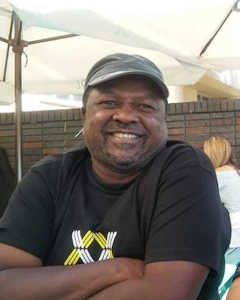 03 December 2021 - On Monday, 29 November, while among a group of community activists preparing the resistance against the coming onslaught of gas, we received the news of Oupa's passing. I felt an immediate emptiness. At the same time my sorrow and grief were held by the very space and people I was with. I was with activists. Planning the resistance against the assault of neoliberalism and false solutions to our climate crisis was exactly where Oupa would have wanted us to be.
We paused our meeting. We reflected on Oupa and his life of supporting activist intellectualism. People in the room, from the Vaal, the Highveld, south Durban, Limpopo, the Karoo, all spoke about being shaped by Oupa. Always constructively pushing activists to think and act critically and expand their own intellectual boundaries was how many remembered Oupa.
Vacancy - Executive Director: Environmental Justice Fund
Closing date: 10 January 2022
The Environmental Justice Fund is a new fund whose vision is that environmental justice prevails in South Africa, where all people enjoy an environment that is not harmful to their health and wellbeing, and the environment is protected for the benefit of present and future generations.
The Fund acknowledges that supporting those most affected by environmental injustice to design and implement their responses, is our best chance of reversing the tide of environmental destruction and building a better, sustainable, and just world. The Fund, therefore, supports the CBOs that drive these campaigns to be sustainable, accountable, agile, resilient, creative, and networked into the broader environmental justice movement in South Africa.
The Fund invites interested and suitably qualified candidates to apply for the position of Executive Director of the Fund. The appointed director must have a clear understanding of how building and resourcing activism, on the ground, in communities affected by pollution and environmental degradation will have long-lasting significant advancements to the environmental and climate justice movement.
A Second Gas-to-Power Environmental Authorisation is refused for Richards Bay
02 December 2021 - A second floating gas-to-power plant has been refused its Environmental Authorisation (EA) in the Port of Richards Bay. Much like the refusal of the EA for the Karpowerships l on 24th June this year, the 6500MW Nseleni Independent Floating Plant (NIFPP) barges and its associated infrastructure, such as the 2800MW Liquid Natural Gas (LNG) receiving and storage facilities power barge terminals and overhead cabling bridge for the evacuation of power to the National Grid, were refused due to the high negative impacts to the estuarine environment and lack of proposed mitigation measures.
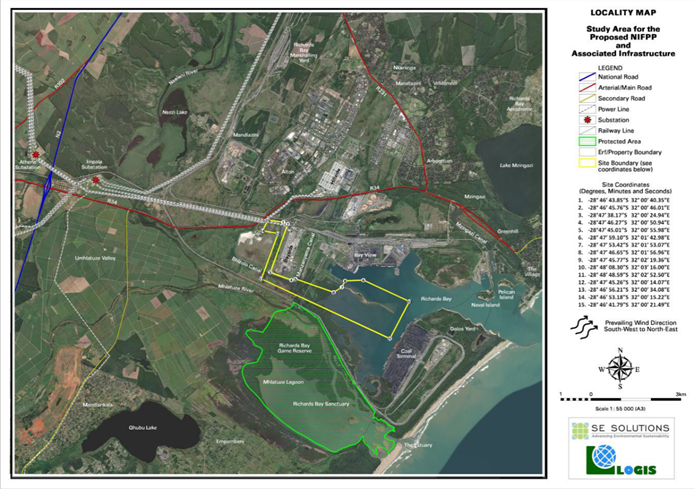
Proposed site of the NIFPP and associated infrastructure. Picture source: Sahris.
The decision to refuse the EA raised the following: Cumulatively, there are expected negative impacts to the ecosystem, including avifauna, estuary and marine environments. Macrobenthos, that is, organisms living on the bottom of the water body, are particularly vulnerable to dredging activities proposed by Nseleni. Adequate monitoring programmes of estuarine birdlife were not conducted, and insufficient and inefficient mitigation measures were put in place to counter the negative impacts on the affected ecosystem and its local communities.
In addition to NIFPP’s EA refusal on the 19th of November 2021, Nseleni’s Water Use License (WUL) was also refused on 25th November. The refusal raised the fact that the dredging of the sea bottom would lead to severe impacts on the estuarine environment, piling and other activities interfering with the flow of water, as well as, heated water discharge into the ocean resulting in impacts on marine ecology.
Impacts on important wetlands such as uMhlathuze Estuary, Richards Bay Estuary and Kabeljous flats were not adequately assessed and proper geohydrological impact assessments were not conducted. Negative impacts on estuaries and ocean will also affect fish spawning grounds, fish, fisherfolk, fishing communities and the ecotourism sector that provides jobs and livelihoods to the local communities of Richard’s Bay.
Hazardous waste gathering in Durban - Environmental justice movements and affected communities put together plans to fight and tackle toxic waste
01 December 2021 - South Africa does not have a clear toxic waste plan and this has resulted to a number of injustices in different corners of the country. Thirty years after Thor Chemicals was exposed for importing mercury contaminated toxic waste and operating a sub-standard recycling plant which polluted local water and resulted in the deaths of workers. This is but one example of the toxic waste legacy that South Africa is dealing with. Hundreds of millions of tonnes of current and legacy mining waste contaminated with heavy metals and uranium under the stewardship of the Department of Minerals and Resources, is an ongoing mismanaged health risk to neighbouring communities.
Over the years, groundWork has maintained a National Waste Campaign and led civil society efforts for a National Waste Act that was promulgated in 2008. groundWork has helped expose a series of scandals concerning incinerator operators, supported action to close down polluting medical waste incinerators and forced the transition to less harmful non-burn technologies. More recently poorly managed toxic dumpsites such as Midrand, Shongweni, DCLM and Aloes have sparked public health outcry in neighbouring communities. Industrial production in the Highveld, South Durban, the Vaal triangle, Richards Bay, Pinetown and Pietermaritzburg are some of the places that experience industrial toxic stench from dirty production. In some instances, waste is being incinerated either in cement kilns or industrial incinerators and people are suffering as a result.
It is for this reason that groundWork brings together partner organisations across Africa and within South Africa to mobilise against unsustainable waste management practices, fighting incinerator proposals and challenging legacy toxic waste dumps.
Details
Venue: Blue Waters Hotel, Durban
Date: Wednesday 01 December 2021 – Thursday 02 December 2021
Time: 08:30 – 16:00
Contact Person: Musa Chamane, 082 380 2237, musa@groundwork.org.za
Changes in the groundWork Environmental Health Team - Welcoming Azeeza Rangunwala and Mafoko Phomane
29th November 2021 - We are delighted to announce that Azeeza Rangunwala and Mafoko Phomane have joined the groundWork Environmental Health Campaign.
 Azeeza, is our new Global Green and Healthy Hospital (GGHH) Coordinator effective from the 1st November. This builds upon the incredible work started by Luqman Yesufu, groundWork's first GGHH coordinator, in establishing the GGHH campaign in South Africa and across the continent.
Azeeza comes into this position with over 6 years of experience working for Gauteng Health as an Assistant Director for Research, Policy and Capacity Building. Azeeza has been involved in policy formulation and managing projects that are in line with Sustainable Development Goals and the National Development Plan. She was instrumental in developing Safety, Health, Environment, Risk, Quality (SHERQ) policy in the Department that guided the occupational health and safety aspects of readjusting to the COVID-19 pandemic in public healthcare facilities. Azeeza has a master's degree in Medical Virology, and a Postgraduate Diploma in Public Management. Health, integrity, truth, justice and activism are core values that inform her career choice.
Azeeza will work closely with Luqman Yesufu over the next two months before he leaves groundWork at the end of the year. Luqman has worked with groundWork since 2013 as our first GGHH Coordinator. From a humble start he has grown the GGHH campaign in South Africa and Africa where today more than 99 members, representing the interest of 6,032 hospitals and health centers working collaboratively under the GGHH banner across the continent.
Luqman Yesufu: “I have personally worked really closely with Azeeza, while rolling out the GGHH in Gauteng Province and I have seen first-hand her dedication, commitment and passion for the environment and people’s health. She will be an awesome addition to the team.”
 Mafoko, is our new Environmental Health Campaigner, effective from the 1st November. Mafoko is a public health professional and researcher with over 15 years of experience in the public health and development sectors in South Africa and Lesotho. She has held project coordinator and research positions at the Rural Health Advocacy Project with Wits Health Consortium in South Africa, as well as district-level HIV program roles at the Ministry of Health in Lesotho. Mafoko holds a Master of Public Health degree, a Post-Graduate Diploma in Human Resources, and monitoring and evaluation experience.
Mafoko will work closely with Rico Euripidou, who headed groundWork’s Environmental Health Campaign since 2007. Rico has as of June 2021 taken over a new role in groundWork as the Campaign Coordinator, a new position created in groundWork to manage and support campaign staff in the strategic alignment of groundWork’s six campaigns.
Rico Euripidou: “We are excited to have Mafoko join the groundWork family. Mafoko’s expertise and experience will strengthen the Environmental Health Campaign to give a stronger voice to groundWork’s push for just transition based upon equity, health, and justice. We are fortunate to have Mafoko take her next step in her career with us.”
Bobby Peek, Director, groundWork: “We are excited that Azeeza and Mafoko have chosen to join groundWork. We believe that their experience, energy and groundWork activism will strengthen both the health sector and those living on the frontline of environmental injustice to engage effectively and shape the just transition we need to deliver on the promises of our hard fought for democracy.”
No time left: Sasol faces the heat for inadequate climate change commitments at its AGM
19 November 2021 - Environmental groups and shareholder activists once again joined Sasol’s AGM to challenge the fossil fuel giant for its lacklustre climate commitments and inadequate detail in its climate change strategy.
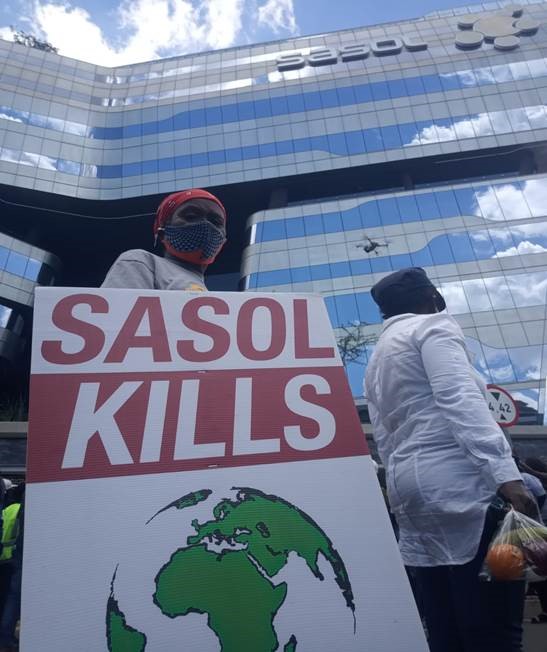
Activists protest outside Sasol head offices in Sandton, Johannesburg Pic: LifeAfterCoal
Civil society organisations and shareholder activists confronted Sasol during its 2021 Annual General Meeting (AGM), held on Friday, 19 November 2021, to challenge the company’s plans to continue using coal until 2050, its heavy reliance on gas as a “transition” replacement feedstock, and lack of adequate, detailed plans to reduce greenhouse gas (GHG) emissions.
Sasol remains one of the world’s worst GHG emitters
Sasol is South Africa’s second-highest emitter of GHGs, after Eskom. Its Synfuels plant in Secunda, Mpumalanga, is the largest single-source point of GHG emissions on the planet and its pollution is a serious threat to human health. Sasol is also among the 100 companies estimated to be responsible for 71% of global GHG emissions, and one of the 90 corporate entities responsible for two-thirds of global carbon emissions between 1850 and 2010.
Carbon Criminal Sasol Shows No Real Signs of Reforming Dirty Operations
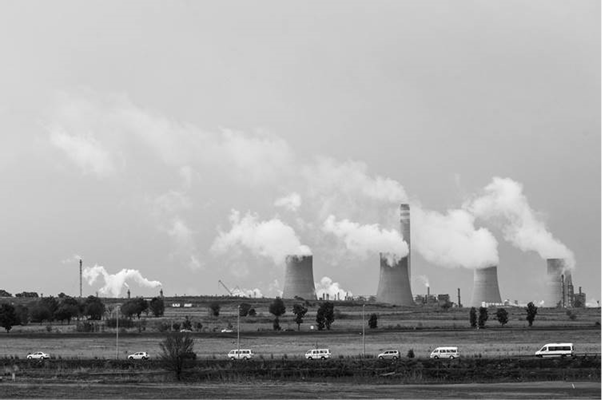
Sasol plant in Secunda, Mpumalanga Image: Daylin Paul
18 November 2021 - Civil society organisations, shareholders, environmental activists, and affected communities are set to confront Sasol at their annual general meeting on Friday 19 November 2021. Sasol, one of the biggest climate culprits globally, has previously failed to provide clear and detailed plans to reduce its greenhouse gas emissions and transform its operations. Sasol is also accused of bullying and showing total disregard towards communities where it operates.
Sasol has asked shareholders to endorse, on a non-binding, advisory basis, its climate change ambition, strategy and actions during the 19 November AGM. Given the multiple concerns with Sasol’s plans, shareholders should vote against Sasol’s plans.
For over a decade, Sasol has avoided compliance with air pollution standards and delayed meaningful reductions of climate-changing GHGs. Sasol’s new target to triple (to 30%) emission reductions by 2030 is highly unlikely to be achieved. It has not set any short-term decarbonisation milestones until 2026 (other than its plans to procure 200 MW of renewable energy) and there is very little prospect of accountability for Sasol’s current management team, if the targets are not met.
Sasol currently does not meet any of its annual GHG emissions reduction goals. In fact, its emissions have increased in the two years (2020 and 2021) since it first set an emission reduction target in 2019, despite the urgency to reduce GHG emissions to limit the worst impacts of the climate crisis. In 2021, Sasol emitted 57, 352 Mt at its Secunda operations alone.
Sasol Annual General Meeting: Protests
On Friday, 19 November 2021 Sasol will hold its Annual General Meeting. Civil society organisations, environmental activists, and affected communities will take part in protest action against Sasol. The protests will be complemented by shareholder activism at the AGM which will be held virtually.
Protest Action Details
KwaZulu-Natal
Thursday, 18 November 2021
07h00 am – 11h00 am
Along the KZN coastlines, in 5 locations:
Richards Bay - Contact Israel 076 781 2193
Umkomaas - Contact David 083 467 1380
Isipingo - Contact Riaz 084 253 1157
South Coast - Contact Marco 061 920 91380
Snake Park Fishing Pier - Laila 060 399 3962
For more information, contact: South Durban Community Environmental Alliance on 031 461 1991
Gauteng
Friday, 19 November 2021
11h00 - 13h00
Assembly point: George Lea Park, Sandton
End point: Sasol Head Offices, 50 Katherine Street, Sandton
For further information contact:
Tsepang Molefe
groundWork, Friends of the Earth South Africa
+27 74 405 1257
media@groundwork.org.za
Youth-led #CancelCoal climate case launched against government’s plans for new coal-fired power
17 November 2021 - Three civil society organisations this week launched landmark constitutional litigation in the North Gauteng High Court against the South African government, demanding that it abandon plans to build 1 500 MW of new coal-fired power on grounds that new coal-fired power poses significant unjustifiable threats to constitutional rights.
The burning of coal is the biggest contributor to global climate change, in addition to unacceptable health impacts caused by air and water pollution. Government’s current plans to build 1 500 MW of new coal-fired power in South Africa are costly, unnecessary and an unjustified limitation of the Section 24 right to an environment not harmful to health and wellbeing, along with other rights, and should be abandoned. There is no justifiable basis for the limitation of constitutional rights because cleaner and less harmful renewable energy is both a feasible and cheaper alternative to new coal power.
This is the central argument of the #CancelCoal court case, launched this week by the youth-based African Climate Alliance (ACA), the community-based Highveld group, the Vukani Environmental Justice Movement in Action (VEM) and groundWork (gW), represented by the Centre for Environmental Rights (CER), against the Minister of Energy and the National Energy Regulator of South Africa (NERSA).
Constitutional Court dismisses coal mining company’s bid to start mining
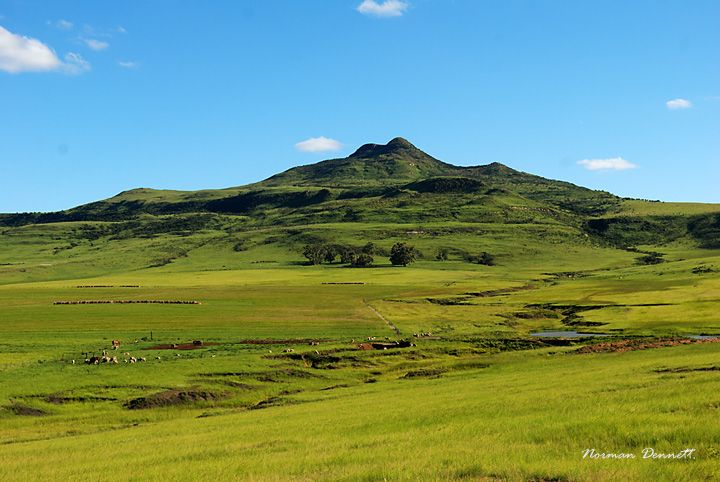
Wakkerstroom vista. Photograph: Norman Dennett
11 November 2021 - Civil society coalition welcomes the Constitutional Court decision to dismiss coal mining company Uthaka Energy’s leave to appeal a 2021 High Court interdict, preventing the company from commencing mining in a Strategic Water Source Area.
The Constitutional Court’s decision leaves intact a Pretoria High Court interdict granted earlier this year, which prevents Uthaka (formerly called Atha Africa Ventures) from conducting any mining activities for the proposed Yzermyn coal mine near Wakkerstroom in Mpumalanga, South Africa.
The decision is the latest milestone in a long-running legal battle by a coalition of eight civil society organisations, represented by the Centre for Environmental Rights (CER), to overturn the approvals given for the mine. At present there are six court challenges pending before the High Court.
Let’s not forget those that stood up to corporate power and the elite - In memory of Ken Saro-Wiwa, Fikile Ntshangase and ‘Bazooka’ Radebe.
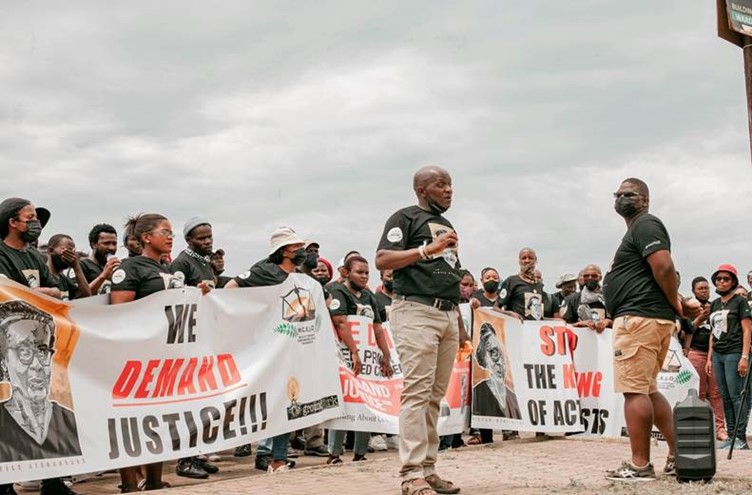
Activists during the #JusticeForFikileNtshangse protest march in Mtubatuba on the 22nd of October 2021.
Pic. Lunga Bhengu
10 November 2021 - Today Africans commemorate the day that Ken Saro-Wiwa and his fellow activist were murdered by the Nigerian state 26 years ago, as a result of their resistance to Shell in Ogoniland, Nigeria. The eight others community activists were, Saturday Dobee, Nordu Eawo, Daniel Gbooko, Paul Levera, Felix Nuate, Baribor Bera, Barinem Kiobel, and John Kpuine from Ogoniland. They - the Ogoni Nine – were hanged by the government of Sani Abacha, because of their resistance and opposing the exploitation of oil by Shell.
Africa United Against Dirty Coal Power
08 November 2021 - To date, as evidenced by the record, the prospects of nations delivering on pledges are dismal and implications for climate justice within the present world order are bleak. When the chips are down, international solidarity goes begging. The pattern is repeated in response to so-called ‘natural’ disasters, including climate disasters, where donor pledges do not match what is needed and actual aid does not match the pledge. Of the $1.4 bn that was pledged for reconstruction in Mozambique after cyclones Idai and Kenneth, only $193 mn was available in 2020.
Those that signed onto the Global Coal to Clean Power Transition Statement “commit to work together to make clean power the most affordable and accessible option globally, with ensuing economic and health benefits as we build back better from the COVID pandemic.” While such statements are commended we need to see the money. Critically a shift has happened for the 68 signatories, of those 7 being African states, ditching the false solutions of carbon capture utilisation and storage. This is a victory for many organisations that are part of the Africa Coal Network and many others who campaign for real action, rather than false promises.
The Powering Past Coal Alliance also made a big push and bragged about adding to their membership. However membership from Africa is still minimal with only 2 countries, Angola and Mauritius committing to moving beyond coal, and only 1 sub-regional government, the eThekwini Municipality, South Africa.
Executive Director: Environmental Justice Fund
Closing date: 30 November 2021
The Environmental Justice Fund is a new fund whose vision is that environmental justice prevails in South Africa, where all people enjoy an environment that is not harmful to their health and wellbeing, and the environment is protected for the benefit of present and future generations.
The Fund acknowledges that supporting those most affected by environmental injustice to design and implement their responses, is our best chance of reversing the tide of environmental destruction and building a better, sustainable, and just world. The Fund, therefore, supports the CBOs that drive these campaigns to be sustainable, accountable, agile, resilient, creative, and networked into the broader environmental justice movement in South Africa.
The Fund invites interested and suitably qualified candidates to apply for the position of Executive Director of the Fund. The appointed director must have a clear understanding of how building and resourcing activism, on the ground, in communities affected by pollution and environmental degradation will have long-lasting significant advancements to the environmental and climate justice movement.
WARNINGS NOT HEEDED: Death of an Activist - The story of Fikile Ntshangase and how warnings about assassination and intimidation of activists were ignored
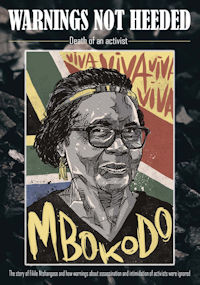 22 October 2021 - This is the story of Mama Fikile Ntshangase, a dynamic and
courageous mother, grandmother and retired teacher from South Africa's KwaZulu-Natal province, who was assassinated
while preparing dinner in her home in the closing months of 2020.
22 October 2021 - This is the story of Mama Fikile Ntshangase, a dynamic and
courageous mother, grandmother and retired teacher from South Africa's KwaZulu-Natal province, who was assassinated
while preparing dinner in her home in the closing months of 2020.
In this report we detail the events leading up to the murder of Ntshangase and some of the most likely reasons she was killed. But the story is not just about Mam' Fikile. Sadly, it echoes similar and increasingly common stories from marginalised communities around the world who have been driven from their land – or been forced to stay on the land and suffer the consequences – due to the avarice of corporate and political elites which often cloaks self-serving motives beneath the more noble clothing of the "national interest" or economic and social "development".
You can also read the letter to the President of the RSA, from groundWork Director Bobby Peek, co-signed by 133 activists here. The letter calls for the President to intervene to ensure that the SAPS take the necessary steps to bring those responsible for the murder of activists to justice.
Groups call on World Bank President David Malpass to be replaced over failure on climate action
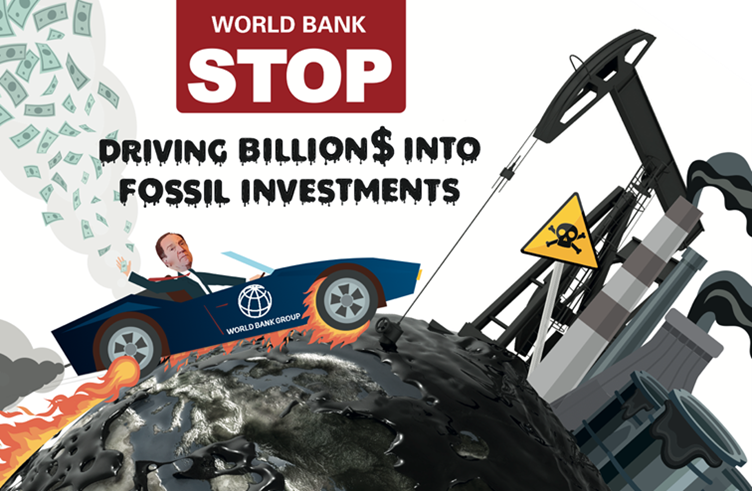
14 October 2021 — 77 groups have sent a letter to World Bank Governors and Executive Directors calling for President David Malpass to be replaced for failing to take adequate action on climate change. The groups also called on Executive Directors to establish stronger climate and social justice qualifications for management personnel responsible for the Bank’s climate and energy work. The call comes during the 2021 Annual Meeting of the World Bank Group.
“The World Bank has a long history of brushing up its green credentials and putting itself at the centre of climate finance while supporting the expansion of fossil fuel extraction and use", says David Hallowes, researcher for groundWork and the Life After Coal Campaign. "In the face of intense opposition from environmental and social justice organisations in South Africa, it granted Eskom a massive loan to build the disastrous Medupi power station. It claimed the project would help alleviate poverty and help Eskom achieve financial stability and adopt a low-carbon trajectory. These justifications were always spurious. The Bank’s real purpose, then as now, was to sustain the extractive economic order.” says Hallowes.
WE DEMAND JUSTICE!!!
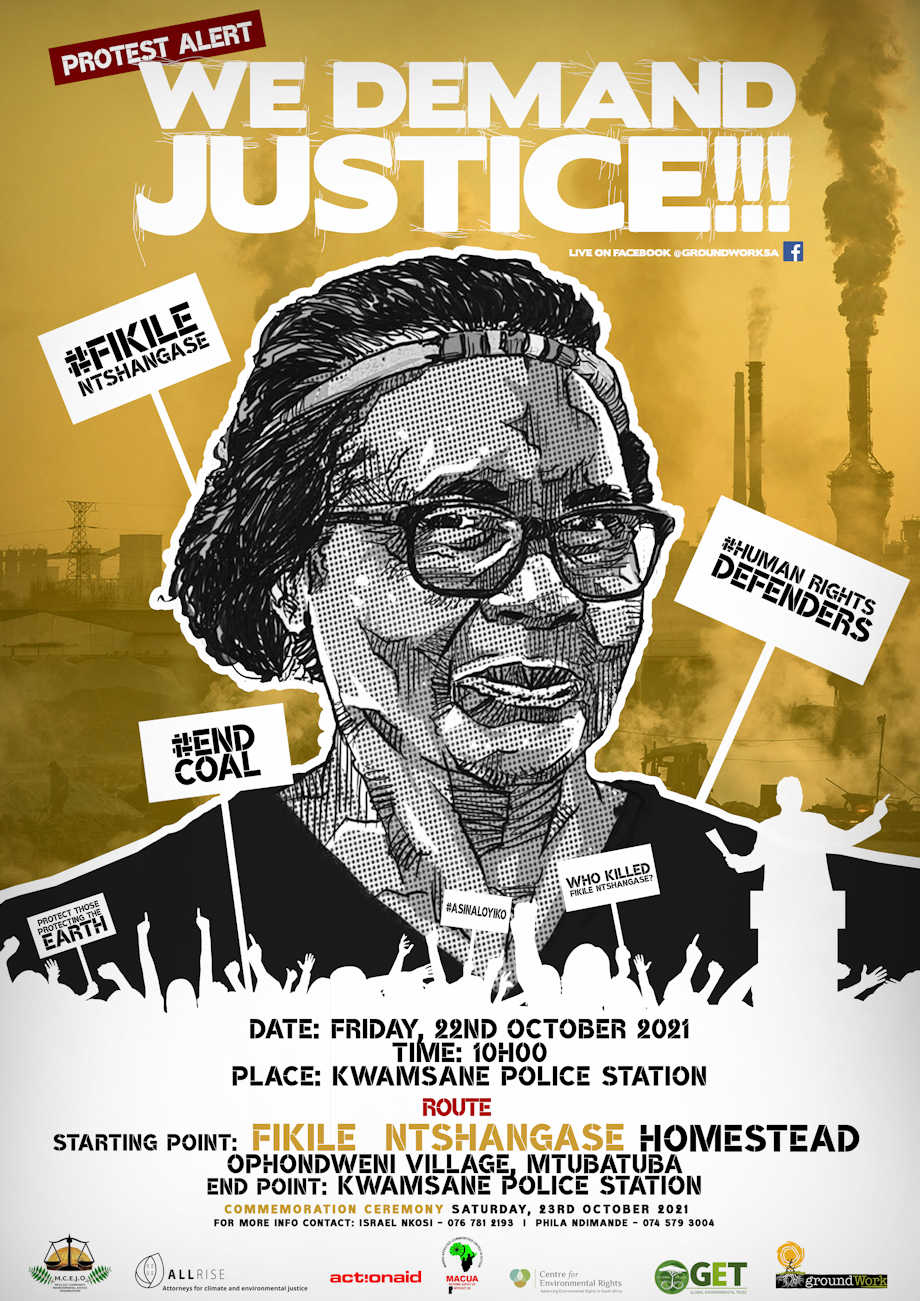
Friday 22nd of October 2021 will mark a year since the brutal murder of Somkhele, Mtubatuba activist Fikile Ntshangase. Environmental justice movements and organisations around the country will descend to Mtubatuba in the north of KwaZulu-Natal not only to remember Ntshangase but also to DEMAND JUSTICE through a protest to KwaMsane Police Station where activists and community members affected by coal mining in the area will hand over a memorandum of demands related to the violence, threats and intimidation they are subjected to.
For more information contact: Tsepang Molefe/groundWork Friends of the Earth South Africa on +27 74 405 1257 or at media@groundwork.org.za
Global health community calls for climate action ahead of COP26 to avert “biggest health threat facing humanity” - WHO report calls for ambitious climate commitments as the only path to long-term recovery from pandemic
11 October 2021 – The Public Health Association of South Africa (PHASA) today calls on the government of South Africa to commit to climate resilient, low carbon, sustainable health systems, with a transparent process for tracking these commitments. The call comes ahead of the UN climate conference (COP26) in Glasgow, UK as more than 300 organizations representing at least 45 million nurses, doctors and health professionals worldwide – about three quarters of the global health workforce – signed an open letter to the 197 government leaders and national delegations ahead of COP26, warning that the climate crisis is the single biggest health threat facing humanity, and calling on world leaders to deliver on climate action (1).
The letter’s publication coincides with the release today of a new report by the World Health Organization (WHO), which argues that countries can only ensure a long-term recovery from the COVID-19 pandemic by implementing ambitious climate commitments. The report delivers ten high-level recommendations, backed up by action points, resources and case studies, including the need to place health and social justice at the heart of the UN COP26 climate talks (see note 2 below for full list of recommendations).
The letter states: “Wherever we deliver care, in our hospitals, clinics and communities around the world, we are already responding to the health harms caused by climate change. Those people and nations who have benefited most from the activities that caused the climate crisis, especially fossil fuel extraction and use, have a great responsibility to do everything possible to help those who are now most at risk.”
Life After Coal Says South Africa Must Walk the Talk at Cop26

07 October 2021 - The Life After Coal campaign (comprising the environmental justice groups groundWork and Earthlife Africa, and public interest environmental law group the Centre for Environmental Rights) calls on South Africa to meet the lower bound of its new climate target range by accelerating the coal phase-out and renewable energy build, and to lead on demanding increased financial support from wealthy nations for adaptation and loss and damage at this month’s climate meeting in Glasgow.
Last month, Cabinet approved an updated Nationally Determined Contribution (NDC) in terms of the Paris Climate Agreement. This NDC includes the greenhouse gas emissions limits that South Africa has committed to adhere to - for 2025 and 2030.
Only the lower bound of South Africa’s Updated NDC target range (of 350 to 420 Mt CO2eq) is broadly consistent with the 1.5°C pathway the world needs to avoid the worst impacts of climate change. To meet that lower bound target within the timeframes set, urgent action must start now.
groundWork Director Bobby Peek's address to the Environmental Grantmakers Association 2021: Global Liberation and Environmental Justice, 6 October 2021
Deadly Air: Eskom is now world's most polluting power company
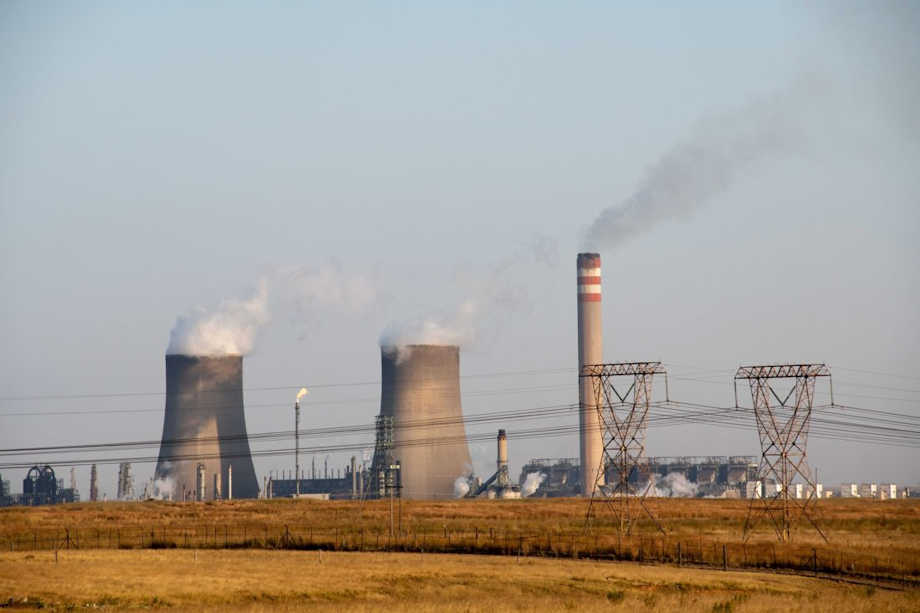
06 October 2021 - The Centre for Environmental Rights (CER) reports that new research from the Centre for Research on Energy and Clean Air (CREA), shows that Eskom is now the largest emitter of health-harming sulfur dioxide (SO2) in the world. These findings stand in stark contrast to the World Health Organisation's recently updated guidelines on ambient air quality and highlight the fact that unless Eskom complies with domestic air pollution laws or decommissions its older plants, South Africa is unlikely to attain safe air quality, particularly in the Mpumalanga Highveld.
The new expert research and recently strengthened WHO guidelines underscore the vast gulf that the soon-to-be-appointed expert panel on air quality standards in South Africa must try to bridge, if the country is to move from its comparatively weak national ambient air quality standards (NAAQS) and status as an air pollution hotspot, to a future in which millions of South Africans no longer have to breathe poisonous air.
If we don’t take climate action now, this is what life in South Africa will look like
28 September 2021 - Two new expert reports explore what life in South Africa will be like over the course of the next 50 years if we continue with a business-as-usual approach to climate change. Their findings are unequivocal: unless we act now, climate change will become increasingly dangerous, for everyone.
The reports, commissioned by the Centre for Environmental Rights (CER) for the African Climate Alliance, groundWork, the Vukani Environmental Movement in Action, both examine what life in southern Africa will look like if we continue on the current “worst case scenario” climate trajectory, leading to global surface temperature increases of 3°C to 4°C above the 20th century average in the second half of the century.
Southern Africa warming at twice the global rate
The first report, titled Climate impacts in southern Africa during the 21st Century examines how climate harms will impact the southern African region, with a particular focus on changes to long-term weather patterns, agriculture and food security, water availability and biodiversity.
The report underscores the fact that southern Africa is particularly vulnerable to climate change, with warming in the interior of southern Africa occurring at about twice the global average rate.
“Substantial changes in the number of extreme temperature events in southern Africa can already be detected,” confirms Engelbrecht. “Further drastic increases in events such as heat waves, high fire-danger days and oppressive temperatures impacting on human comfort and health can be expected under futures in which climate change mitigation efforts are low or unsuccessful.”
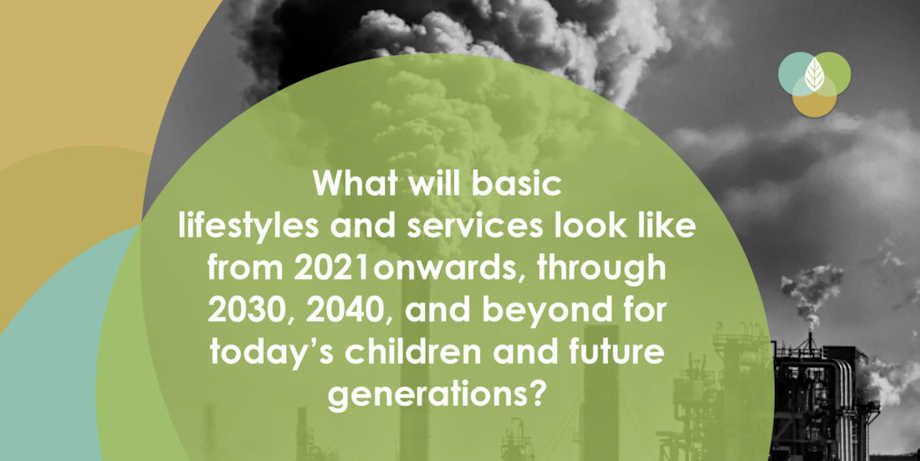
The second report, authored by global change expert Prof Nicholas King, considers what basic lifestyles and services will look like for future generations by 2030, 2040 and beyond, with a particular focus on the Western Cape, Limpopo and Mpumalanga, due to climate change impacts.
China to stop coal build out in Africa: A victory for community resistance in Africa
22 September 2021 - Today, more than 120 African community organisations and non-government organisations meeting virtually for the 3rd African Coal Conference welcome Chinese President Xi Jinping’s statement that China will not build new coal-fired power projects abroad.
The meeting sees this as a victory for the thousands of community activists in Lamu, Kenya; Sengwa and Hwange, Zimbabwe; Ekumfi, Ghana; Senegal; San Pedro, Ivory Coast; Makhado, South Africa and the many other sites here and across the Global South who have challenged their governments and China, and said no to coal.
The Conference has gathered from Monday, 20 September and is hearing testimonies of community organisers from more than 20 countries across Africa who are challenging coal. The call is to stop coal and initiate a just transition in our communities and countries.
A just transition must be delivered via an open democracy where people can shape the future of their communities, cities and countries.
#CancelCoal coalition demands government cancel plans for new coal-fired power or face court challenge
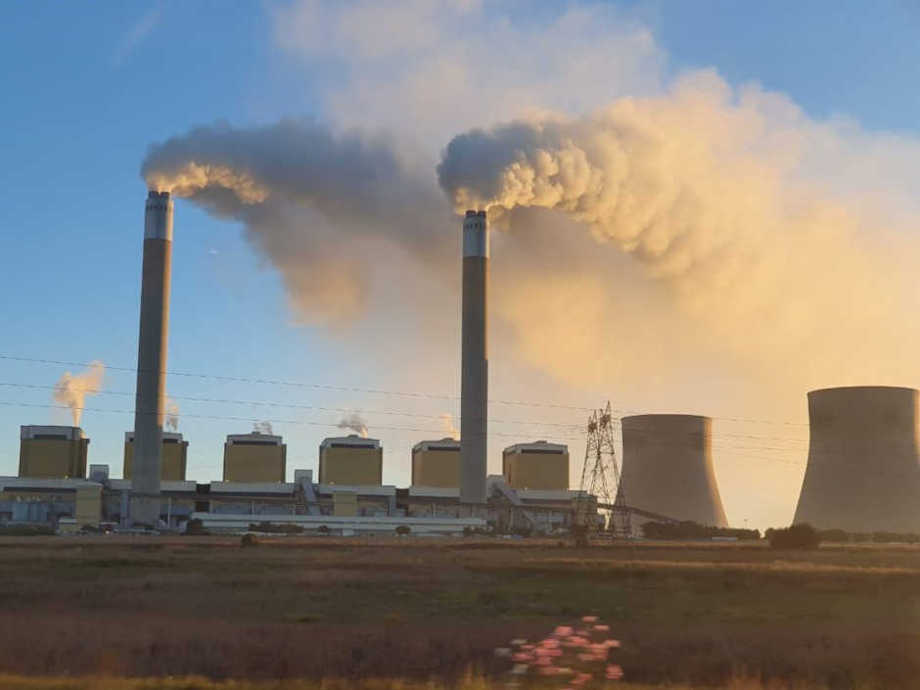
22 September 2021 - A letter of demand from environmental and climate justice groups calls on Minister Mantashe and NERSA to abandon plans to develop 1 500 MW of new coal-fired electricity or face legal action.
The development of new coal-fired power is neither rational nor lawful, given the well-documented environmental, social, human health and economic impacts of new coal-powered electricity generation in South Africa. As such, government’s current plans to build new coal-fired power are an unjustified violation of constitutional rights and should be revoked.
This is the message of the letter of demand sent to Minister Mantashe on 17 September 2021 by the Centre for Environmental Rights (CER) as lawyers for environmental and climate justice groups the African Climate Alliance (ACA), the Vukani Environmental Justice Movement in Action (VEM) and groundWork (gW).
The letter highlights global scientific consensus on coal and climate change, citing the recently published Intergovernmental Panel on Climate Change report on the physical science basis of climate change that confirms that the state of our climate is even more precarious than previously thought, and that greenhouse gas emissions must be urgently and steeply reduced to avoid dangerous global warming.
The letter also refers to the expert findings of two locally-focused expert reports. The first details the unnecessary cost of new coal-fired electricity generation, and the second demonstrates that, since no coal-fired power can be considered clean, regardless of the type of technology that is used, building new coal power in circumstances where there are cleaner, cheaper and feasible alternatives, would result in unacceptable harms and simply makes no sense.
AFRICA COAL NETWORK ANNUAL CONFERENCE - 20 to 22 September 2021
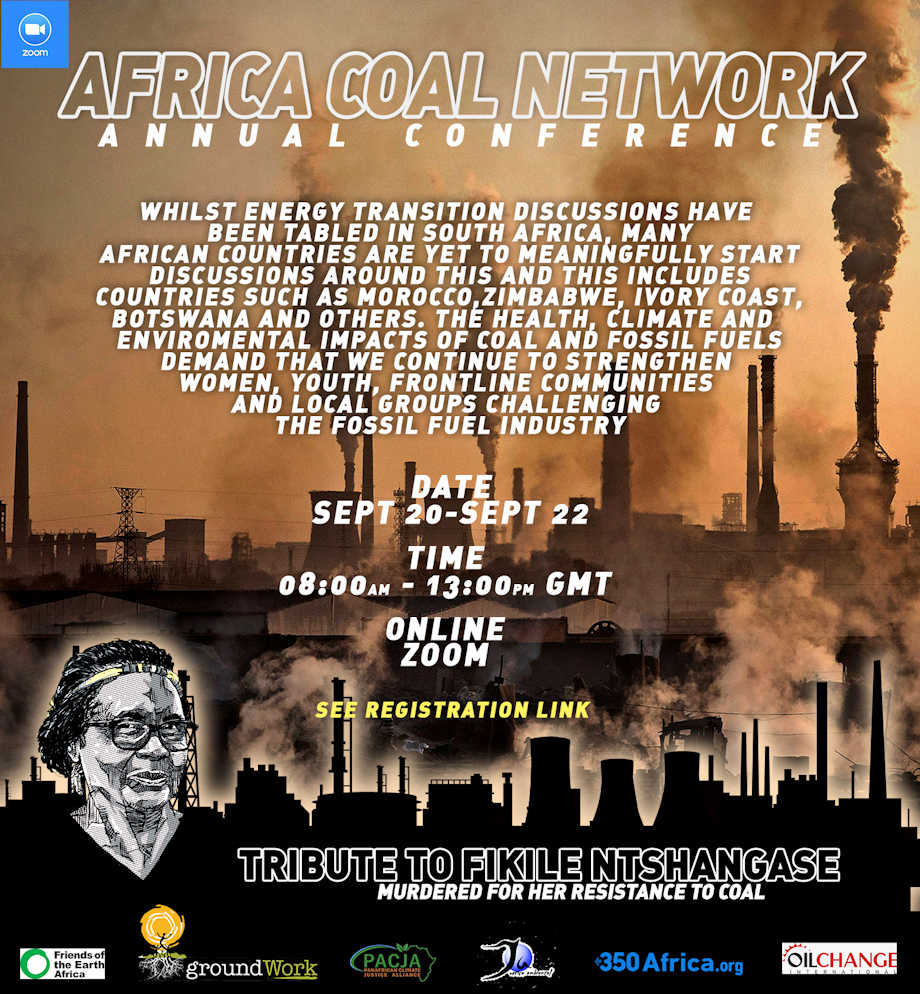
14 September 2021 - Whilst Energy Transition discussions have been tabled in South Africa, many African countries have yet to meaningfully start discussions around this and this includes countries such as Morocco, Zimbabwe, Ivory Coast, Botswana, and others. The health, climate, and environmental impacts of coal and fossil fuel demand that we continue to strengthen women, youth, frontline communities, and local groups challenging the fossil fuel industry.
Vukani Environmental Movement and groundWork announce the passing of Dumi Mkhuma
 14 September 2021 - It is with a deep sadness to announce the untimely passing of our fellow comrade Dumi Johannes Mkhuma. Dumi was an active member of VEM (Vukani Environmental Movement) an environmental justice community organisation in the Highveld, Mpumalanga.
He was a resident of Vosman, KwaGuqa in Witbank and openly spoke out about the health implications of air pollution in his community. His long battle with Asthma and lived experiences in the frontlines of the coal struggle were circumstances that he was able to draw inspiration from as an activist.
We thank Dumi and his family, for his contribution in the environmental justice movement.
Aphumule ngokuthula
Climate change will have “profound adverse mental health implications” for those living in South Africa
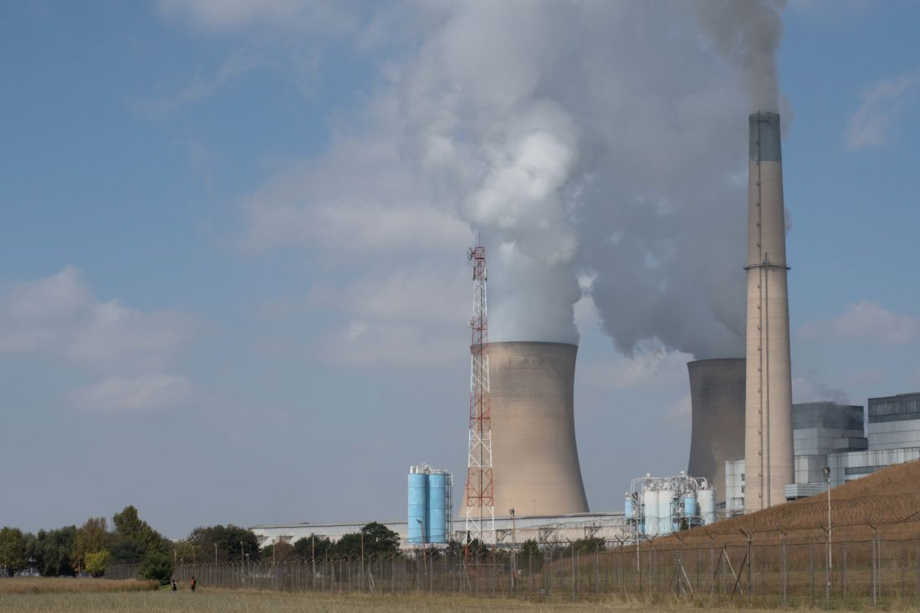
07 September 2021 - A new report by community psychology expert, Dr Garret Barnwell, shows that climate change harms are already negatively impacting our mental well-being and these effects will only accelerate in the future, placing today’s youth and future generations in harm’s way.
The findings of the report, commissioned by the Centre for Environmental Rights (CER) for the African Climate Alliance, groundWork, and the Vukani Environmental Movement in Action, are clear: climate change poses a severe threat to the mental health and well-being of present and future generations – and people living in South Africa are particularly vulnerable to these effects.
“It is extraordinarily difficult for the majority of South Africans to adapt to the advancing climate shocks, such as climate change-exacerbated disasters, water insecurity and economic losses. The same social conditions that make individuals and communities more vulnerable to climate change, are the same that put people at higher risk of mental illness and psychological adversities,” Barnwell explains.
Government's plan to procure 1500 MW of new coal-powered electricity generation risks exacerbating the immediate and long-term effects of climate change in South Africa, through increasing greenhouse gas emissions. In the report Barnwell describes the harms of these climate effects, stating that, “Numerous studies that have been cited show that greenhouse gas-emitting energy sources have detrimental physical, mental, and neurocognitive consequences.”
You can read the full media release and download the report here.
Just Recovery Renewable Energy Plan for Africa Launched by Friends of the Earth Africa - 50 organisations endorse the Plan
 01 September 2021 - Friends of the Earth Africa today launched ‘A Just Recovery Renewable Energy Plan for Africa’ which offers a practical and much-needed opportunity to change the trajectory of energy development, distribution, and access on the African continent. The report stresses the urgency to democratise energy systems, reduce the power of transnational corporations and enable peoples and communities to access sufficient energy to live a dignified life.
The report which was launched during a webinar with key climate justice voices demands a complete shift from current dirty energy systems to achieve 100% Renewable Energy in Africa. The plan found that it is technically and financially feasible, with an annual investment requirement of around US$130 billion per year. It lays out clear targets for this vision, with over 300GW of new renewable energy by 2030, as agreed by the African Union, and over 2000GW by 2050. It also shows that the finance and investment needed to achieve the 100% renewable energy goal can be done through public finance from the global North, ending tax dodging and dropping the debt.
LAUNCH: 1 September 2021, Just Recovery Renewable Energy Plan for Africa
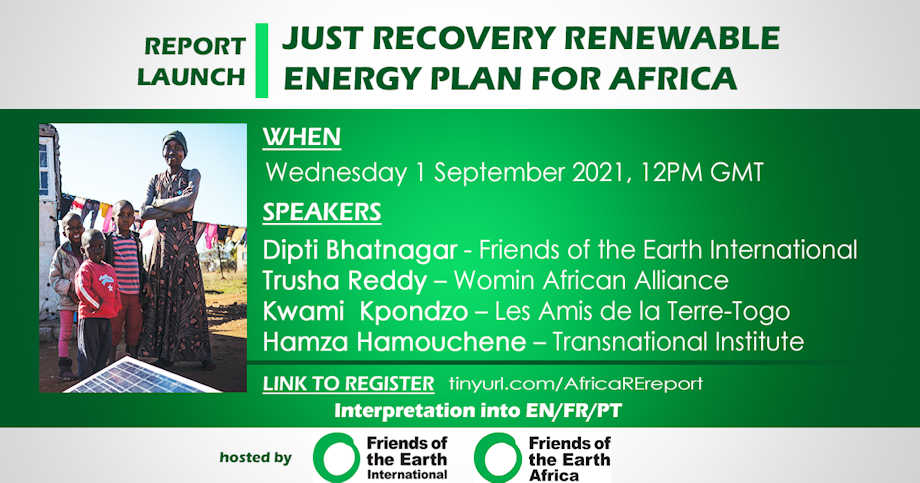
Friends of the Earth Africa will be launching our report ‘A Just Recovery Renewable Energy Plan for Africa’ via a webinar on Wednesday, 1 September 2021, 12pm (GMT/UTC). Webinar languages are English, French and Portuguese.
The report looks at the reality of renewable energy options in Africa and uses modelling to build a series of demands around building a just recovery based on a 100% renewable energy system for the peoples of Africa.
The report itself will be released also on 1 September 2021 on these websites: www.foeafrica.org and www.foei.org.
We have an exciting panel that brings voices from different parts of our region:
- Dipti Bhatnagar of Friends of the Earth International – will speak to the report contents
- Trusha Reddy from Womin African Alliance - will address the issues of Gender and Renewable Energy and bring southern African perspectives
- Kwami Kpondzo of Les Amis de la Terre Togo - will discuss Renewable Energy from the west African perspective
- Hamza Hamouchene from Transnational Institute - will provide some input on Renewable Energy perspectives from North Africa
- Moderated by Avena Jacklin, groundwork, South Africa
Please join us for an exciting launch and panel. Here is the link to register:
tinyurl.com/ or
https://us06web.zoom.us/meeting/register/tZMlcOyoqj4sEtVpf1udcRV6XExahjdgkMzj
After registering, you will receive a confirmation email containing information about joining the meeting.
The report launch is also accompanied by the launch of a political statement demanding renewable energy for Africans, signed by 49 African organisations.
For any questions or queries, email ferrial@foei.org
Environmental justice groups urge NERSA to deny Karpowership licences
19 August 2021 - Objections submitted to the National Energy Regulator of South Africa (NERSA) by the Centre for Environmental Rights (CER), on behalf of groundWork, urge the energy regulator to deny Karpowership’s applications for electricity generation licenses in recognition of the projects’ high costs, climate change impacts and lack of demonstrated ability to comply with environmental laws and deliver energy justice for the poor.
The objections provide more evidence to show that pursuing Karpowership’s projects at Saldanha, Ngqura and Richards Bay is not in the public interest and would needlessly expose South Africa to a range of risks and harms by locking the country into costly gas power for the next 20 years.
New report exposes myth of clean coal
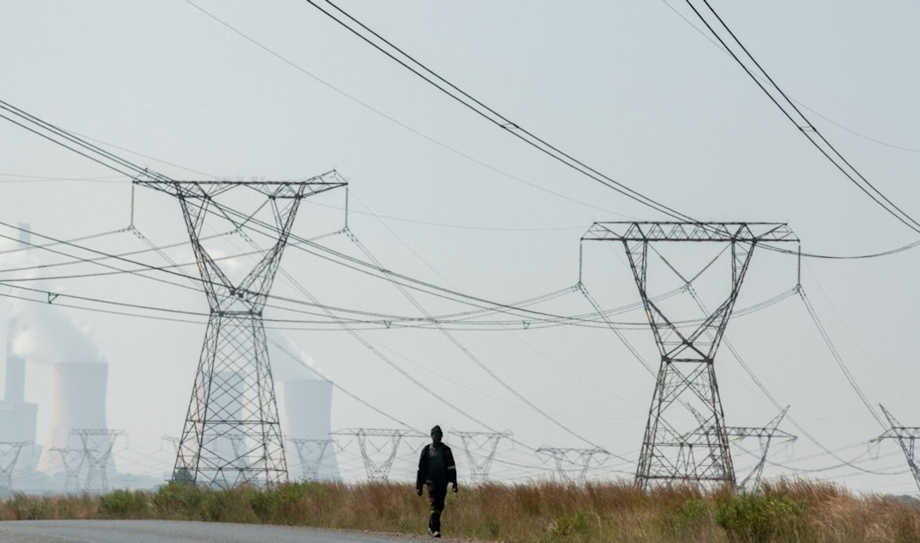 18 August 2021 - A new report by air pollution expert, Dr Ranajit Sahu, confirms that South Africa’s proposed 1500 MW of new coal-powered electricity generation will cause significant air pollution and greenhouse gas emissions, even if the cleanest technology currently available is used.
In 2019 the South African government proposed adding 1500 MW of new coal generation in the country, as part of the Integrated Resource Plan for Electricity (IRP). The IRP claims that such coal generation will be cleaner because high-efficiency, low-emission (HELE) generation technology will be used, although it does not state which kind.
Dr Ranajit Sahu, an engineer with over 30 years’ experience in power plant design, assessed the potential air emissions of the most likely types of HELE technology that could be used as part of a report commissioned by the Centre for Environmental Rights (CER ) for groundWork, the Vukani Environmental Movement in Action, as well as the African Climate Alliance.
Sahu found that even in the best-case scenario in which the cleanest available technology is used, large quantities of greenhouse gas emissions are unavoidable.
Durban Residents Demand Transparency and Full Disclosure of Dangerous Chemicals, Pesticides or Goods Stored in Vulnerable Logistics Parks and an End of Hazardous Trucks’ Travel as well as a Move Towards a Just Transition
11 August 2021 - SDCEA (South Durban Community Environmental Alliance) has addressed an Open Letter to the National Department of Environment, Fisheries and Forestry, and the KwaZulu-Natal provincial Department of Economic Development, Tourism and Environmental Affairs in which it is demanded that there be transparency and full disclosure of all dangerous chemicals, pesticides, or other harmfull goods stored in vulnerable logistics parks. The letter further calls for an end to the movement of trucks conveying hazardous materials through community areas, as well as a move towards a just transition
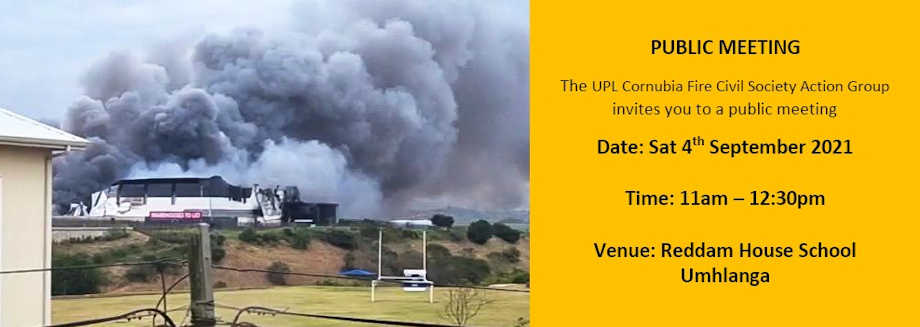
The Cornubia chemical plant fire: Aftermath of the riots should not leave behind a toxic legacy
29 July 2021 - Open letter to the Board and Management of UPL, Fortress Real Estate Investment Trust, eThekwini Municipality and to national and provincial environmental authorities
In mid-July, South Africans had to fight for their constitutional democracy. As the dust settles, we are fighting for the openness of that democracy. The intent behind the 1996 Constitution was not only to establish democratic self-rule, but to ensure an ‘open and democratic’ society, based on the values of human dignity, equality, and freedom. Openness is non-negotiable for the people of South Africa to enjoy their constitutional right to an environment ‘not harmful to health or well-being’, and for our socio-economic rights.
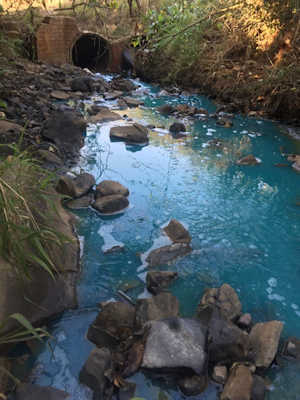 But openness is being trampled on in the handling of the chemical fire that broke out on 12 July 2021 at a warehouse owned by Mumbai-based chemicals multinational United Phosphorous Limited (UPL) in Cornubia, north of Durban. The building, which is irreparably damaged, is owned by Fortress Real Estate Investment Trust.
Residents and affected stakeholders have been denied essential information about chemicals and related by-products stored at the warehouse. As a result of the fire, and attempts to hose it down, these have escaped into airways and waterways, contaminating water, air, and soil. Since either looters or economic saboteurs set the factory alight, community complaints have flooded in:
“We have a strong pungent smell and [are] inhaling this. My 2 [dogs] have vomited up white/grey substance for the past few days and my …[child] was very ill last night. We have all had sore throats and itchy eyes”.
“People have had scratchy throats and raw feeling eyes’, ‘in our household we had one person with asthma which was exacerbated with greatly restricted breathing on Thursday and Friday nights and nausea and vomiting”.
“We also had cats vomiting on Friday”.
Nearby residents have expressed concern that ‘this deeply concerns us as these fumes, we believe will lead to health problems further down the line.’
Climate litigation by civil society results in new guideline on climate change impact assessments
The draft guideline signals an important move towards considering climate change in environmental decision-making. However, government is urged to broaden and strengthen the scope of the guideline.
29 July 2021 - Civil society groups have welcomed a proposed new guideline for assessing climate impacts of new developments. The publication of this guideline is one of the outcomes of precedent-setting climate litigation by civil society groups challenging new climate damaging developments. The guideline is a step in the right direction to avoid further emissions in line with South Africa’s commitments under the Paris Climate Agreement, loss of life due to climate change and also to prepare for the risks posed by climate change to new developments.
The Centre for Environmental Rights (CER), on behalf of environmental justice groups groundWork and Earthlife Africa, have submitted a written response to the draft National Guideline for the Consideration of Climate Change Implications in Applications for Environmental Authorisations, Atmospheric Licences and Waste Management Licences. The CER, groundWork and Earthlife form part of the Life After Coal Campaign.
The comments urge government to rely on science and the law to provide a firm benchmark against which greenhouse gas (GHG) emissions should be reduced.
Given the far-reaching nature of the climate crisis and its impacts, government is also urged to publish similar guidelines for the consideration of climate change impacts for a much broader array of licences and decision-making processes – particularly water use licences.
Urgent (unofficial) Public Health Warning by Concerned Civil Society Organisations Following the UPL Pesticide Warehouse Fire in Durban
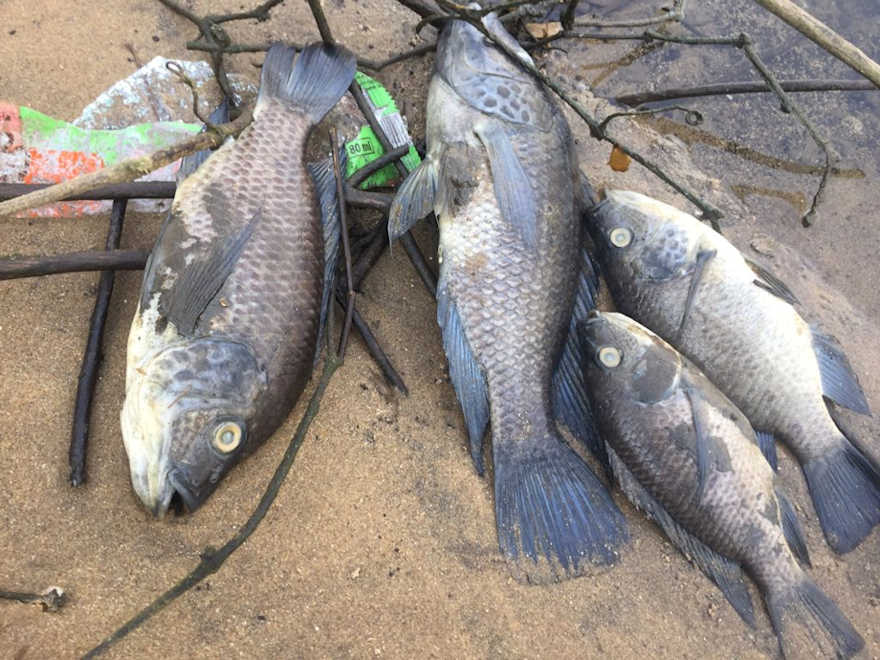
21 July 2021 - The South Durban Community Environmental Alliance and groundWork are issuing a public health warning to residents of Umhlanga, Umdloti, La Lucia, Durban North and surrounding areas in lieu of the potentially hazardous toxic chemicals that were released into the environment (air, water, soil) as a result of the UPL- pesticide warehouse in Cornubia, north of Durban burning down during the unrest last week.
We are advising citizens to take urgent public health precautions to reduce their exposure until we have a comprehensive picture of this chemical incident.
The following measures are the safest approaches to adopt as we await a full inventory of the chemicals that were in the warehouse fire:
- Avoid swimming, surfing, or other recreational activity in the river or ocean nearby;
- Avoid eating any fish or other sea life (shellfish etc) obtained from these waters;
- As far as is possible, stay indoors as much as you can, with windows closed, particularly if your home is in the direction of the chemical plume. If you, your child, or elderly people with chronic chest and heart disease live in the area of the smoke, and it is at all possible to stay with relatives outside the area for the next few days, then it is advisable to do so; and
- Consult your doctor or report to the emergency department at your hospital or clinic if you experience symptoms.
If you were exposed to the smoke of the fire or contaminated water, and depending on your level of exposure, potential acute health effects might include:
- Watery eyes and redness;
- Scratchy throat and irritation of the nose;
- Altered taste in the mouth, and possible excessive salivation; and
- Gastro-intestinal symptoms like nausea, vomiting, and diarrhoea (especially if people have ingested contaminated sea life);
These symptoms will generally be mild, and resolve once removed from exposure without treatment. However, if residents with pre-existing conditions such as asthma, chronic respiratory diseases, and heart problems experience an aggravation of their usual symptoms, such as a tight chest, shortness of breath, wheezing and are not responding to their usual medication, please seek health care immediately. Similarly seek health care if your symptoms continue to deteriorate.
We are also concerned about longer-term (chronic) effects. However, because of the failure by the industry and government to disclose the details of the pollutants, at this point in time, we are unable to state exactly what these symptoms are likely to be.
Should anyone experience any of these symptoms or symptoms suspected to be related - please urgently call this emergency number immediately on the EThekwini air pollution hotline 031 311 3555 or alternatively the emergency hotline 031 361 0000 to report on how you are affected by this pollution. Please insist on getting a reference number and forward the reference number by email to: bongani@sdceango.co.za or WhatsApp - 069 120 4970 for further investigation.
In the event of serious health effects please call the Poisons Information Helpline 086 155 5777
When we learn the results of the environmental tests which are currently being conducted we will adjust our advice to people on how to protect themselves.
For more information please contact:
Desmond D'Sa, South Durban Community Environmental Alliance (SDCEA) - 083 982 6939
Rico Euripidou, groundWork, Friends of the Earth - 083 519 3008
Rajen Naidoo, Professor and Head, Discipline of Occupational and Environmental Health, University of KwaZulu-Natal - 082 437 9333
Kamini Krishna, Property and Environmental Attorney, Umhlanga - 083 448 5855
Thoughts About Our Times in South Africa
14 July 2021 - groundWork has always been in solidarity with people at the frontline and fencelines of struggles against environmental injustice and corporate power. Environmental injustice has been brought about by the power of capital – together with the political elite – seeking to force and use labour and nature to turn a profit. They have done this by excluding people from democratic decision making, externalising the costs of their pollution onto people and our environments and taken control of public goods and enclosed these. They have done this for profit while also preventing those excluded from this profit seeking system to escape the clutches of capital. This cannot be denied.
Evidence abounds: from the Guptas, Karpowership and the mines not wanted by community people yet forced upon them, to Sasol given leeway to pollute and harm people’s health because they need profit, and government forcing people to pay for basic services and water, knowing that they do not have the money to pay for it, while spending billions to finance business rescue bailouts for entities looted by them, their comrades, and cronies.
So given this context, how does environmental justice feature in the mayhem and looting in our country? Many commentators have spoken about why we are in this mess. From Abahlali baseMjodolo, South Africa’s leading social movement for people living in shacks, to ex-head of Stats SA, Mr Pali Leholhla on The Watchdog. They are clear that over the last 27 years, government has ignored the people and the stats highlighting the challenges of the poor and the youth. Our leaders have failed to deliver. According to New Frame, a not-for-profit, social justice media publication based in Johannesburg, government and the elite also ignored the reality of the growing numbers of unemployed and hungry people. The Zuma incident was therefore the ‘spark to the tinder’, they argue. But it is important to recognise that ‘the ANC failed to sort out its politics when the Zuma matter was for its members only to resolve,’ as Cyril Madlala reflects upon in The Daily Maverick, and the current crisis is therefore broader than Zuma and has been a long time in the coming.
Case Against Activists Fighting Ikwezi Coal Mine in Newcastle Withdrawn
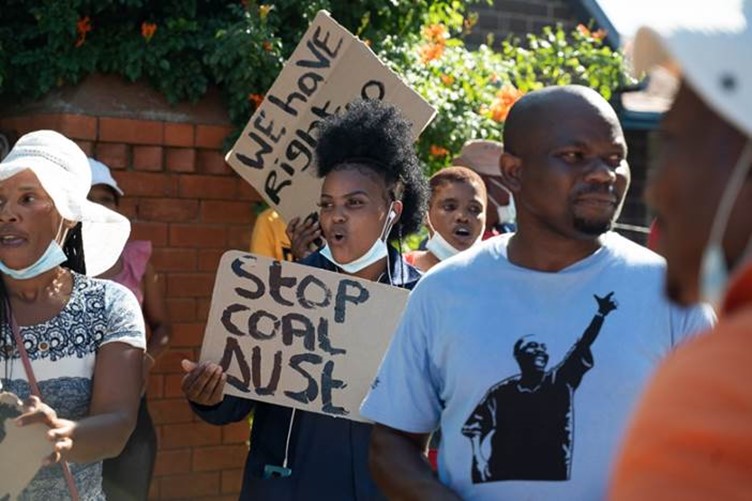
Activists protesting outside the Dannhauser Margistrate Court. Image: Jasmine Sarwoko
01 July 2021 - The case against three young women activists in Dannhauser has been withdrawn. Sindi Kubheka, Buhle Kunene, and Zanele Kubheka appeared yesterday in the Dannhauser Magistrate’s Court. Magistrate Ngema provisionally withdrew charges of public violence against the three accused, pending further investigations.
The three were part of the eight activists that were arrested on the 12th of March 2021. They first appeared in court on the 15th March 2021. They were part of the community group protesting against the operations of Ikwezi Coal Mine in Dannhauser, KwaZulu Natal, South Africa. The initial two-day protest was sparked by the coal mining impacts in the community of Mbabane in Dannhauser, where Ikwezi operates a coal mine. The prosecution failed to present before the court visual CCV footage that was mentioned as evidence implicating the three on a charge of public violence directed at the police.
Karpowerships Refused Environmental Authorisation
25 June 2021 - On Thursday 23 June 2021 the Department of Forestry, Fisheries and the Environment (DFFE) made a decision to refuse all three Karpowership Environmental Authorisation (EA) applications for gas to power at the Ports of Richard’s Bay, Nqgura and Saldanha Bay.
Karpowership SA (Pty) Ltd is a Turkish company that received preferred bidder status in the Department of Mineral and Energy’s (DMRE’s) Risk Mitigation Independent Power Producers Program (RMIPPP), as announced by Minister Gwede Mantashe on 18th March 2021. The company applied for three environmental authorisations for the ports of Richard’s Bay (KwaZulu Natal), Nqgura (Eastern Cape) and Saldanha Bay (Western Cape). The commenting period for the Environmental Impact Assessments closed on 31st March. After consideration of shortcomings in the EIA process, Department of Forestry, Fisheries and the Environment (DFFE)’s Chief Director of Integrated Environmental Authorisations, Mr Sabelo Malaza, issued letters for the refusal of all three Environmental Authorisations.
The decision followed warnings, comments and correspondence submitted by specialists, government authorities and civil society organisations. Several organisations including Richard’s Bay Clean Air Association (RBCAA), BirdLife South Africa, SANPARK, Oceans Not Oil (ONO), South Durban Community Environmental Alliance (SDCEA), Masifundise Development Trust, Green Connection, Centre for Environmental Rights (CER) and groundWork submitted comments to the EIA. Several irregularities and deficiencies were picked up by the organisations.
Victory for Pietermaritzburg Residents: High Court orders uMsunduzi Municipality to come up with detailed and comprehensive plan on dumpsite.
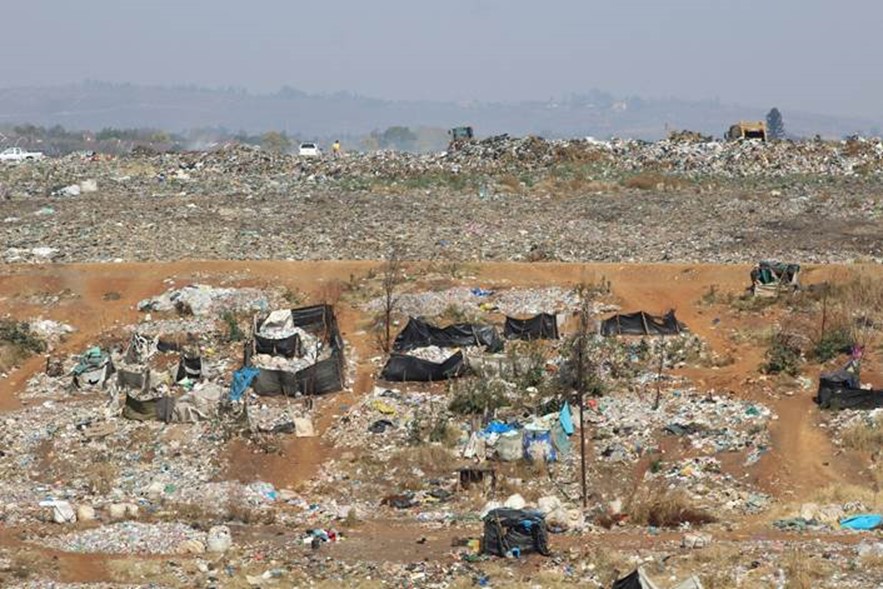
The New England Landfill site in Pietermaritzburg. In a case brought before the court by South African Human Rights Commission against the uMsunduzi Municipality, the High Court in Pietermaritzburg has found the municipality to be in violation of the Constitution and environmental legislation, due to its poor management of the landfill site. image: Tony Carnie
17 June 2021 - The High Court in Pietermaritzburg has delivered judgement in the South African Human Rights Commission case against the uMsunduzi Municipality arising out of the Municipality’s failure to properly manage the New England Road Landfill site. In a 41-page judgement delivered today, Judge Seegobin found the Municipality to be in breach of a number of laws that govern waste and the environment, including the breach of the Variation Waste Management License and also of Section 24 of the South African Constitution. The court ordered the municipality to file a detailed and comprehensive action plan with the court within 30 days.
In 2020 the New England Road landfill made headlines in the news for all the wrong reasons, including fires that lasted a week during level 4 lockdown. groundWork, Schools, communities and affected residents had engaged the municipality and tried to compel them to manage the site in an environmentally safe manner. The Department of Environmental Affairs also ordered the city to develop a working plan for the dumpsite and to follow some directives and recommendations from the department, but the uMsunduzi municipality has never given effect to those directives, which resulted in the further deterioration of the site.
New Embedded Generation Projects Must Not Include Dirty Fuels and Leave the Poor Behind
14 June 2021 - While groundWork welcomes the President's announcement on 10th June 2021 that the National Energy Regulator of South Africa (NERSA) licensing threshold for embedded generation projects be increased from 1MW to 100MW, and so exempt them from licensing requirements in order to promote self-generation of power, we remain concerned about the implications of such a move.
Read the full groundWork information brief and the Presidential announcement here.
Launch of the Private Sector Forum on Health in the Informal Sector, 11 June 2021, Sandton ICC, Johannesburg.

11 June 2021 - The South African National AIDS Council (SANAC), and Deputy President David Mabuza will launch the Private Sector Forum of SANAC on 11 June 2021 at the Sandton International Convention Centre, Johannesburg, Gauteng. The global fund has allocated funding to the South African Business Coalition on Health and Aids (SABCOHA) to work with SAWPA in South Africa. Our role is to make sure that we implement pilot projects in two metros in South Africa making sure that waste pickers have access to personal protective equipment (PPE).
The establishment of the Private Sector Forum is an important milestone that will ensure a fully constituted SANAC through a proper representation of the private sector in all SANAC structures. More importantly, it will ensure a better coordinated private sector response and contribution towards the implementation of the national response to HIV, TB, COVID and STIs.
The health aspect of the informal workers especially waste pickers has been overlooked for many years. While we try to make sure that an enabling environment is attained it is also equally important that the heath of waste pickers is taken into consideration. SAWPA is very happy to be part of the project where the private sector forum will be ironing shortcomings experienced by waste pickers on the ground. It is good that this project has a relationship with office of the Deputy President of South Africa.
South Africa’s new Nationally Determined Contributions are delaying the Just Transition.
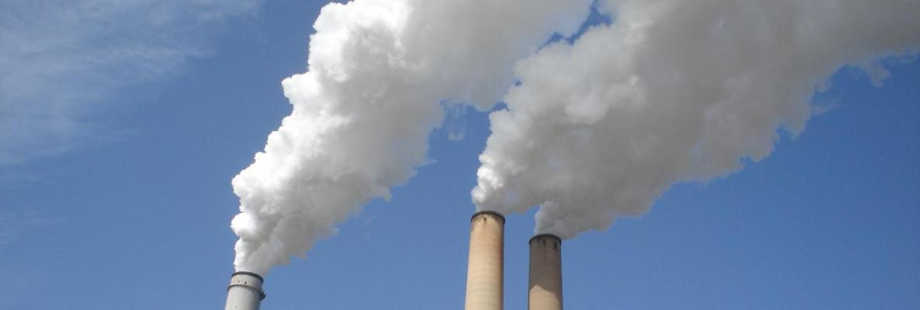
Government policies and processes fail to commit to decarbonization and building a climate resilient society by pushing for dirty fossil fuels that will accelerate climate change.
04 June 2021 - Organisations groundWork and Earthlife Africa (ELA) submitted comments on South Africa’s new Nationally Determined Contributions (NDCs) on 30th April 2021. And on 6th May 2021 community organisations Support Centre for Land Change (SCLC), Vukani Environmental Movement (VEM), Vaal Environmental Justice Alliance (VEJA) and South Durban Community Environmental Alliance (SDCEA) attended the Presidential Climate Commission for Climate Change (P4C) on the NDCs. Communities expressed their concern that Government – and the Department of Mineral Resources & Energy (DMRE) in particular – equates a just transition with a slow transition even as it promotes further fossil fuel developments at all costs.
The Paris Agreement aims to keep global warming to “well below 2°C” and preferably less than 1.5°C above pre-industrial temperatures. The Intergovernmental Panel on Climate Change has since made clear that 2° of warming will be disastrous and “rapid and far-reaching” changes to the economic system are needed to keep temperatures below 1.5°C – or even below 2°C.
To meet this target, global emissions must be reduced by half by 2030 and zero by 2050 and steeper reductions are needed to increase our odds of survival. However, the Paris Agreement relies exclusively on the combination of all the NDCs to meet the target and those submitted in the first round in 2015 added up to global warming of 4°C or more. The second round of NDCs is meant to ‘increase ambition’ but seems highly unlikely to keep us below 3°C, even if all countries do what they promise.
South Africa’s continued reliance on fossil fuels and delayed shift to renewable energy that is socially owned, will continue to make South Africa a pariah in climate justice circles. SA needs to take urgent action now by clearly defining what it is going to do to phase out fossil fuels, by when, and why this needs to occur.
Final nail in the coffin for proposed Khanyisa Coal Power Station - approval for another new coal-fired power station has been set aside by the High Court.
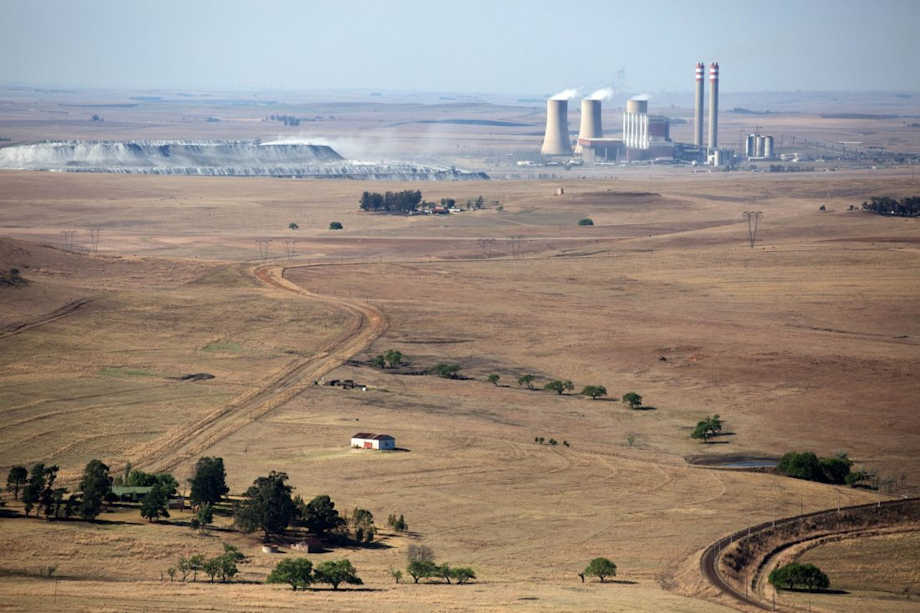
An Eskom coal-fired power station
03 June 2021 - In an order dated 27 May 2021 handed down today, the North Gauteng High Court declared that the environmental approval for the planned 600MW Khanyisa coal-fired power station has expired. Khanyisa would have been built on the outskirts of Emalahleni, already plagued by toxic air pollution.
The court order is effectively the final nail in the coffin for the proposed coal plant – backed by Saudi company ACWA Power – which has met countless legal and other hurdles since its inception.
The ruling came as a result of a legal challenge to the project’s environmental authorisation by environmental justice group groundWork, represented by the Centre for Environmental Rights. groundWork launched the litigation against ACWA Power, to challenge the project, in the Pretoria High Court in 2017. It sought to set aside the environmental approval for the plant on the basis that ACWA Power failed adequately to assess the project’s climate change impacts, and that the Environment Minister (the late Minister Edna Molewa) failed to consider climate change impacts before approving the project.

Trade & Industrial Policy Strategies (TIPS) and the National Labour and Economic Institute (NALEDI), supported by groundWork, invite you to a Webinar on:
People's Voices: Key priorities and challenges for a Just Transition in Emalahleni and Steve Tshwete
Thursday 3 June 2021: 14:00-16:00 (GMT+2) - Zoom
Background
South Africa has initiated a transition to a more sustainable development pathway, which involves moving towards a low-carbon economy. The country is a highly unequal society with many poor and vulnerable people. The need for a just transition has emerged as an imperative, whereby the poor and vulnerable should not be negatively impacted by the transition and should ideally be better off through it. In Mpumalanga, these challenges are exacerbated by the health, air and water pollution that has caused untold death and destruction to people and the environment.
Yet the voice of the people living in affected communities is often not heard, particularly at the national level. This Development Dialogue webinar aims to provide a platform to hear from, and engage with, people from Steve Tshwete and Emalahleni. It aims to unpack key concerns, aspirations, visions and needs for people in Mpumalanga, focusing on what is required to shift the status quo and make a positive change in the region in terms of employment, poverty, energy, health, and the environment. It forms part of a larger project, funded by UK PACT, that intends to facilitate the co-development of a coherent just transition plan for affected communities in Mpumalanga, with a particular focus on Emalahleni and Steve Tshwete.
Programme
14:00 - 14:05: Welcome and introduction, facilitated by Peta Wolpe
14:05 - 14:10: Brief overview of the UK PACT project
14:10 - 14:30: Introduction by Jay Naidoo
14:30 - 15:15: Panel discussion with voices from workers, community business and local government from Steve Tshwete and Emalahleni:
- Lucky Moni, CEPPWAWU
- Promise Mabilo, VEJMA
- Nonkululeko Mthombeni, Emalahleni Municipality
- Alex Khumalo, Minerals Council
15:00 - 15:50: Open discussion
15:50 - 16:00: Wrap-up / Way forward
About the Speakers
Jay Naidoo is a South African public figure and social activist. He is a board member of the Mo Ibrahim Foundation, promoting governance and leadership in Africa. Previously, he was a Minister in President Nelson Mandela's Cabinet and the Founding General Secretary of Congress of South African Trade Unions (COSATU).
Promise Mabilo is the co-ordinator of Vukani Environmental Justice Movement in Action (VEJMA), a community-based organisation in eMalahleni, Mpumalanga. The organisation was established in 2016 with the vision of promoting awareness of and advocating for environmental justice within the Mpumalanga Highveld and the country. Mabilo is an environmental justice activist and an alumni of the groundWork environmental justice school.
Lucky Moni is an Energy Researcher and National Educator at the Chemical, Energy, Paper, Printing, Wood and Allied Workers' Union (CEPPWAWU), based in Mpumalanga.
Nonkululeko Makua is the Climate Change Champion of the Emalahleni Municipality. She is also the Manager for Parks, Cemeteries and Public Open Spaces, in the Environmental and Waste Management Directorate of the municipalities.
Alex Khumalo is the Head: Social Performance at Minerals Council South Africa. He has long-standing experience and expertise in socio-economic development, transformation strategies, community engagement and community empowerment, notably as the Owner and Chief Impact Officer of Lean Logic Solutions, and the Community Engagement Officer at Anglo American Platinum.
About the Facilitator
Peta Wolpe is an Energy and Climate Change Practitioner. She has extensive experience of working in urban energy and climate change, focusing on energy poverty and local level governance and policy. She was the Managing Director of Sustainable Energy Africa (SEA) for over 12 years. She is also an Associate Director of SouthSouthNorth.
Please register in advance for this webinar:
https://zoom.us/webinar/register/WN_BoO4cG03TfCIRJN0O7rQSQ
EMAIL CIRCULATED BY TRADE & INDUSTRIAL POLICY STRATEGIES
JOIN US ON FACEBOOK
FOLLOW US ON TWITTER
CONNECT ON LINKEDIN
www.tips.org.za
forum.tips.org.za
South African Human Rights Commission vs uMsunduzi Municipality - Landfill case to be heard in the Pietermaritzburg High Court on Friday 28 May 2021
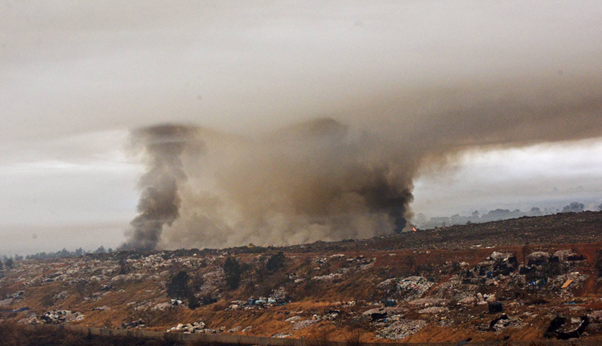
Toxic smoke from the fire in July 2020 at the New England Landfill Site in Pietermaritzburg
28 May 2021 - The case against the uMsunduzi Municipality in Pietermaritzburg is to be heard in the High Court. The Pietermaritzburg landfill site has been in the media for all the wrong reasons dating back to a decade ago. In July 2020 residents experienced the worst incident when the site was engulfed in fire for seven days. Some families had to evacuate their homes due to the smoke emanating from the landfill fire and schools nearby had to shut down. Following its investigation on this matter, the South African Human Rights Commission decided to file an urgent application at the Pietermaritzburg High Court in November last year. The SAHRC expressed its concerns on the environmental and health impacts due to the poor management of the site. The commission accused the municipality of violating the Constitution by mismanaging the site, which is seen as a human and environmental disaster.
Vaal Environmental Justice Alliance (VEJA) Media Statement - ArcelorMittal South Africa 2021 AGM Participation and further Protest Action
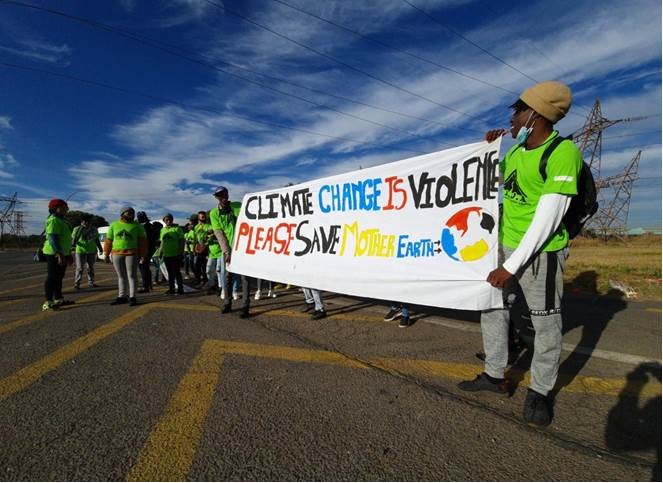
Community activists protesting outside ArcelorMittal in Vanderbijlpark.
20 May 2021 – Today, ArcelorMittal South Africa (AMSA) will hold its Annual General meeting. Due to to Covid-19 the AGM will be virtual. The Vaal Environmental Justice Alliance (VEJA) will once again participate in the AGM to air grievances relating to the company’s failure to protect the environment by reducing its air and water pollution as well as land contamination.
Local communities living in the Vaal Triangle and surrounding areas bear the brunt of AMSA’s pollution. Community members participating in AMSA’s AGM as activist shareholders, remain concerned about the company’s failure to transform its approach to pollution and engagement with communities. We believe that AMSA continues the unscrupulous legacy of its parent company, Iscor Mittal Steel.
Communities of Sebokeng, Sharpeville, Bophelong, Boipatong, and Sasolburg will again be protesting outside ArcelorMittal South Africa Vanderbaijlpark, to hand over a memorandum of demands to management, demanding that ArcelorMittal comply with environmental laws and standards and stop the pollution of air and water. AMSA also needs to manage the safety of their operations and ensure that workers' rights are protected.
Deadly Air Case: The Struggle to Breathe Clean Air in Mpumalanga goes to Court
Landmark #DeadlyAir air pollution case against South African government will be heard in the Pretoria High Court from 17 May 2021 - Two environmental justice groups are asking the High Court to declare the poor ambient air quality in the Highveld Priority Area a violation of the Constitutional right to an environment not harmful to health or well-being.
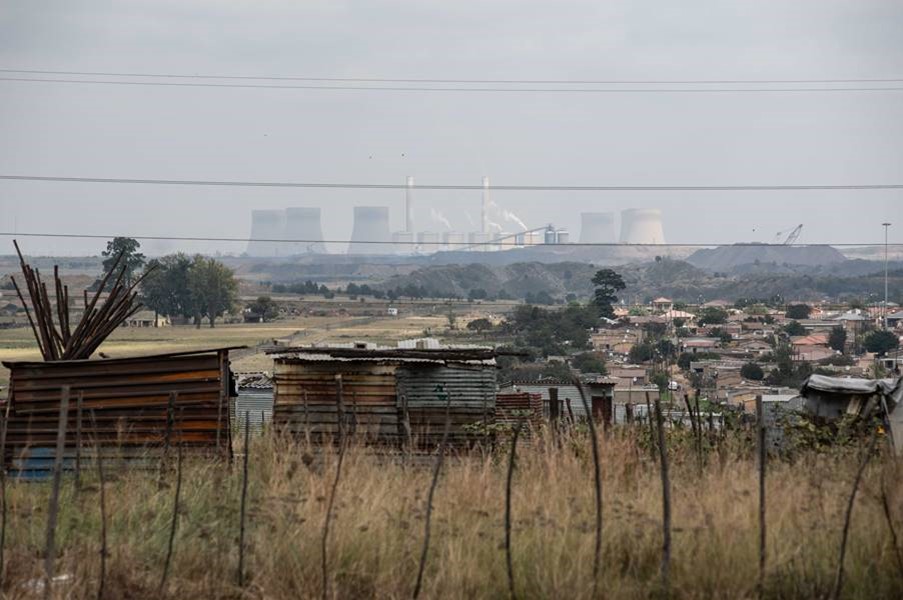
Scenes from Wayawaya settlement on the outskirts of Phola: Image by Daylin Paul
17 May 2021 - Today, the Pretoria High Court will for the first time start to hear arguments in a court case that has become known as the “Deadly Air” case: a case about the toxic air pollution on the Mpumalanga Highveld.
The applicants, Mpumalanga community environmental justice organisation Vukani Environmental Justice Movement in Action (VEJMA) and environmental justice group groundWork are asking the court to declare that the poor ambient air quality in the Highveld is a violation of Section 24 of the Constitution, which provides that “everyone has the right to an environment not harmful to their health or wellbeing”.
The applicants claim that, by failing to improve the deadly levels of air pollution in the Highveld Priority Area (HPA), the South African government has violated the Constitutional right to a healthy environment for the people living and working in the HPA. They are asking the court to order the government to take further steps to improve the air quality in the area.
Government violence against the people of Colombia
16 May 2021 - Since the 28th April 2021, the Colombian people have been mobilising against higher taxes on the country's working class, worsening violence since the signing of the Peace Agreement, and an economic model that has condemned half the population to poverty.
We are monitoring with concern the grave situation of human rights violations caused by the disproportionate use of force by officers of the law. According to the NGO Temblores, in six days of demonstrations, there have been 1181 cases of police violence, including 142 victims of physical violence, 761 arbitrary detentions, 216 violent interventions by security forces, 56 cases of firearms discharged, 9 victims of sexual violence, 17 victims of eye injuries, 56 complaints of disappearances in the context of the demonstrations, and 26 homicides. A government that resorts to military force to quiet the demands of its people is not a democratic one.
Read groundWork's letter to the Colombian Ambassador to South Africa here.
'Deadly air' case truly a matter of life or death
13 May 2021 – In early 2003, landmark litigation was brought by the Treatment Action Campaign against the government. The TAC confronted the government for not providing proven and cost effective medicines for prevention of mother-to-child transmission of HIV to pregnant mothers.
It won the court case on the basis of the constitutional guarantee of the right to health care, and the government was ordered to start programmes for prevention of mother-to-child-transmission of HIV in public health facilities.
As the wheels of justice turned, it became clear that the struggle for ordinary people against HIV would never be the same again and that people could live healthy lives with the virus. The "Deadly Air" case, which will be heard in the Pretoria High Court from May 17 to the 19, is similar to this. The landmark litigation was filed in June 2019 by groundWork and VEM Vukani Environmental Movement with the support of the Centre for Environmental Rights.
Three activists to make their third appearance in Court
The struggle of the Newcastle female activists who were arrested and shot at by the police during a protest against Ikwezi mine continues
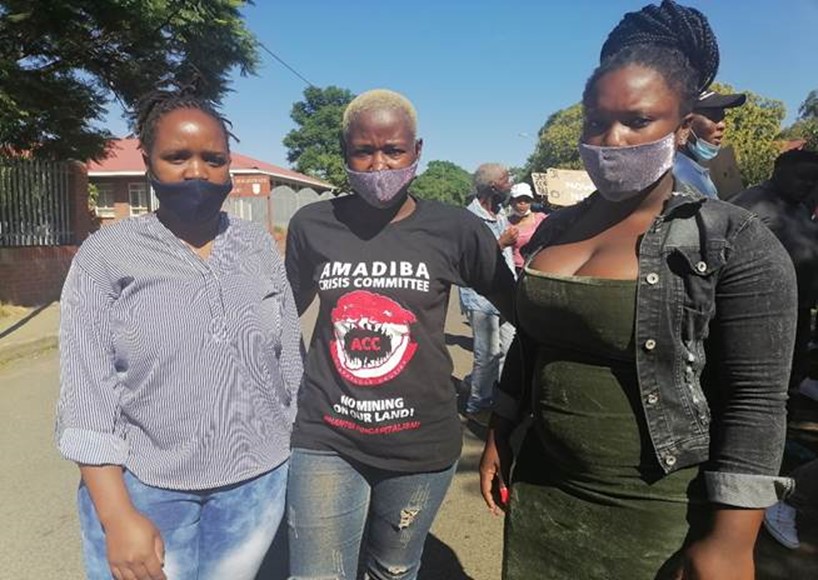
Buhle Kunene, Sindi Kubheka, and Zanele Kubheka outside the Dannhauser magistrate court
10 May 2021- The struggle continues for the three activists who were arrested and shot at by the police on the 12th March 2021 for fighting for their right against the Ikwezi coal mine in Dannhauser – Newcastle. Buhle Kunene, Sindi Kubheka, and Zanele Kubheka will make their third appearance at the Dannhauser Magistrate Court for the charges of public violence. The three were part of a community protest against Ikwezi Coal Mine where police fired rubber bullets at the peaceful protesters.
The activists last appeared in the same Magistrate Court on 12th April 2021 only for the case to be to postponed. The court is expected to make a decision on whether or not to transfer the case to the Regional court. Something positive to draw out of the situation is that the prosecutor decided to drop the second charges of contravening the court interdict against the three.
The three were part of the eight activists that were arrested on the 12th of March 2021. They first appeared in court on the 15th March 2021, where the prosecutor requested for postponement of the case so that she could assess the video footage and see if they were not part of the people who threw stones at the police. The activists expected the video footage to have been viewed and for the decision on whether or not to prosecute them to have also been made, only to find that the prosecutor has not looked at the video footage. We all know that Justice delayed is justice denied. We hope for a better work from the prosecution this time around.
Health Groups Call for Health at the Heart of South Africa’s Climate Commitments
07 May 2021 - South African and pan-African health groups are calling on the South African government to recognise that health is the bottom line of climate change, and to put health at the heart of its climate commitments ahead of this November’s COP26 global climate meeting.
In its public submission on South Africa’s draft updated Nationally Determined Contribution (NDC), the Public Health Association of South Africa (PHASA), the South African Medical Association (SAMA), and Amref Health Africa note that climate change poses severe and numerous threats to human health: “In South Africa, these include exposure to drought, heat (especially for outdoor workers), wildfires, flooding, food security, and mosquito-borne and other infectious diseases”. “At the same time”, added SAMA, “action on climate change offers one of the greatest public health opportunities of the 21st century”. The groups therefore welcome the NDC’s recognition of the constitutional right to a safe and healthy environment, and offer policy guidance in their submission on how this right can be protected and promoted.
NDCs are the 2015 Paris Agreement’s key mechanism for collectively tackling climate change, requiring each country to define a national target and actions to limit global heating. As of May 2021, existing NDCs and country pledges still leave the world on course for a catastrophic 2.4 degrees of heating, however.
Ground-breaking litigation sees organisations challenge new power plant in Richards Bay
All fossil fuels (including gas) are accelerators of the climate threat
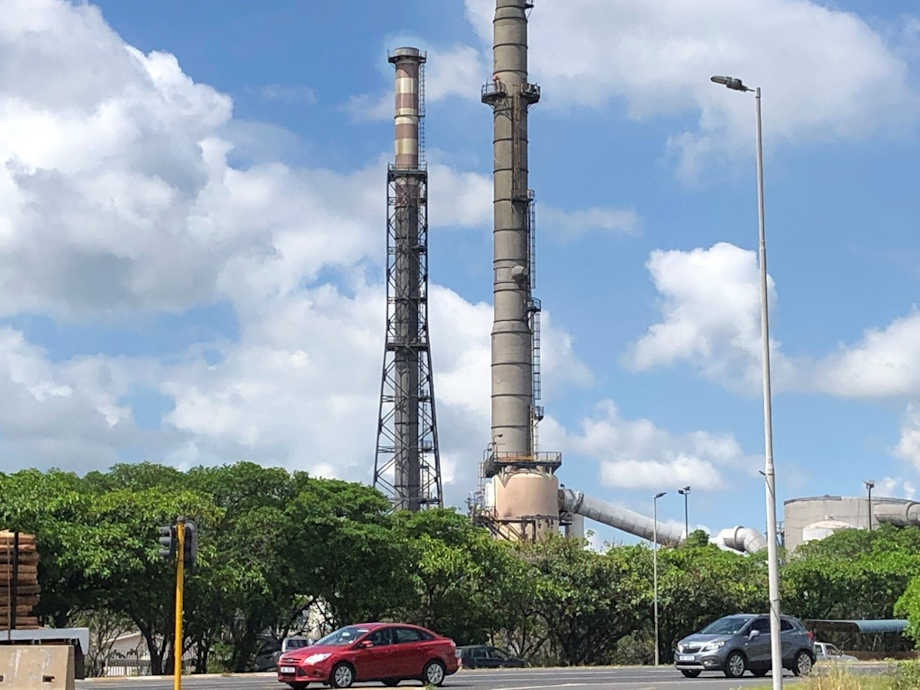
06 May 2021 - In April 2021, the South Durban Community Environmental Alliance (SDCEA) and groundWork filed review papers in the Pretoria High Court challenging the Department of Forestry, Fisheries and the Environment’s authorisation of the Richards Bay 3000MW Combined Cycle Power Plant. This landmark litigation marks the first time that a gas-to-power plant has been challenged in a court in South Africa.
Represented by environmental law specialists, Cullinan and Associates, and supported by the Natural Justice organisation, SDCEA and groundWork are acting in the interests of the public and the environment in challenging the authorisation granted to state-owned public utility, Eskom.
SDCEA and groundWork have approached the High Court to review Minister Barbara Creecy's rejection of the organisations’ appeal against this authorisation.
SA’s revised climate plans are not ambitious enough
Life After Coal Campaign partners Centre for Environmental Rights (CER), groundWork and Earthlife Africa, along with several civil society groups, have submitted comments on South Africa’s draft updated Nationally Determined Contribution (NDC) – the commitment to tackle climate change under the Paris Agreement.
04 May 2021 - In written arguments submitted on 30 April 2021, ahead of Workers’ Day, the Life After Coal campaign has called on government to set more ambitious greenhouse gas (GHG) emission reduction targets in the effort to diversify South Africa’s energy mix.
As Africa’s worst polluter and most industrialised country, South Africa has an important obligation to accelerate its efforts to cut GHG emission reductions, in order to meet its legal obligations under the Constitution, domestic and international laws and secure climate justice that lays the basis for a just transition for the Continent.
In updating its 2015 NDC - South Africa’s voluntary emission reduction targets under the Paris Agreement - the government has sought to tighten SA’s GHG emission targets. However, it has opted for conservative and unambitious GHG emission ranges for 2021 to 2030, with the consequence that much steeper emission reductions would be needed after 2030. This is despite a call from a United Nation’s intergovernmental climate change panel (the IPCC) for the world to halve its GHG emissions by 2030 to stand a chance of avoiding catastrophic climate change.
groundWork and Earthlife Africa submit comments on South Africa’s new Nationally Determined Contributions (NDC) on 30th April 2021.
01 May 2021 - The Paris Agreement aims to keep global warming to “well below 2°C” and less than 1.5°C above pre-industrial temperatures. The achievement of these goals is dependent on the achievement of the NDC to reduce emissions. Global emissions must be reduced by 45% by 2030 and to net zero by 2050. Steeper reductions are needed to increase our odds of survival. The combination of all the NDC submitted in 2015, however, added up to global warming of 4°C or more. The second round of NDC seems highly unlikely to keep global averages below 3°C. Countries are not held accountable to their ‘contributions’ or commitments. And SA fails in this regard. The longer we wait, the further we are from reaching this goal, while increasing climate change impacts, leaving us in a climate emergency.
South Africa’s continued reliance on fossil fuels and delayed shift to renewable energy that is socially owned, will continue to make South Africa a pariah in climate justice circles. The South African government needs to take urgent action now by clearly defining what it is going to do to phase out fossil fuels, within what time framework, and why they need to make this happen. President Cyril Ramaphosa says that the country's response to climate change will be guided by the Presidential Coordinating Commission on Climate Change. The commission will work on a just transition to a low-carbon economy and a climate-resilient society, and will ensure that it is in consultation with the most vulnerable.
Climate change will weigh most heavily on the poor and vulnerable, and so addressing challenges and emerging solutions including adaptation and mitigation measures should focus on this area of society to ensure environmental and social transformation. Poverty and inequality have increased since 1994. The NDC says, “A just transition means leaving no-one behind”. But with no transition at all and 60% of our country in poverty, people are already ‘left behind’. The proposed Long Term Adaptation Scenarios (LTAS) reflect this inequality. Consultation for the NDC is limited. The Department of Fisheries, Forestry and the Environment needs to recognise that government’s primary obligation is to its people and climate response including the NDC should come from a single process of deep and continuing engagement with people within an open democracy framework.
Karpowerships Dodgy Procurement Process Leaves Many Questions Unanswered
29 April 2021 - The procurement of Karpowership services as “emergency” power will lock the country into gas for the next 20 years, increasing electricity tariffs and move us away from the presidential commitment to a just transition and low carbon economy.
On 31 March groundWork submitted Environmental Impact Assessment Report comments for the proposed gas combustion Karpowerships application in all three ports, namely Richards Bay, Saldhanha Bay and the Port of Ngqura.
Community organisations have called for Public Hearings on the Risk Mitigation Independent Powers Producers Procurement Programme (RMIPPP), and the selection of Karpowerships as a preferred bidder, taking the lion’s share of the energy procurement. Civil society has questioned how a foreign-owned company was able to obtain exemptions from local content and put us at further risk to climate change impacts with increased greenhouse gas emissions associated with gas. Renewable energy solutions which are more affordable, sustainable, accessible, and cleaner, with better local content prospects have been deliberately excluded in the build-up to the procurement process.
Total Postpones and Withdraws
.jpg)
14 April 2021 - After months of resisting Total's (TEPSA) application for an Environmental Authorisation (EA) for an additional ten exploration drill wells and seismic testing in Block 11B/12B, the company has withdrawn the application. The proposed exploration was to take place east of the existing exploration wells Brulpadda and Luiperd 1 situated in middle of the Algulhas current off the South African coast near Mossel Bay.
Community groups and organisations groundWork, SDCEA, JA!, Oceans Not Oil, Green Connection, Centre for Environmental Rights, Frack Free SA, Ban Fracking SA, fisherfolk and coastal communities welcome the decision but are seeking clarity on the reasons behind the decision. We await a response from the Environmental Assessment Practitioner, Matthew Hemming of SLR following emails requesting reasons. The SLR’s attached notification letter stated that the Total “has decided to postpose their application for additional drilling” and that the “application for the EA.. has been withdrawn and this ESIA (Environmental and Social Impact Assessment) process has been terminated”. Their Holding Statement released on 14th April 2021 indicate that once geotechnical studies are completed, TEPSA will review its activities and relaunch an application. The findings of these studies will have to be made public. There must be full transparency and accountability for energy decision-making.
Read the full media release and additional documentation here.
The Global Road Map for Zero Emission Health Care
The first-ever guide for how the health sector can align with the Paris Agreement ambition to keep warming below 1.5 degrees
 14 April 2021 - Today, Health Care Without Harm, in collaboration with Arup, will launch The Global Road Map for Health Care Decarbonization: a navigational tool for achieving zero emissions with climate resilience and health equity at the 2021 Skoll World Forum.
The Road Map is the first of its kind to chart a global health care course to zero emissions by 2050. Health care’s climate footprint is already substantial, equaling 4.4% of net global emissions. Without climate action inside and outside the sector, health care’s climate emissions would more than triple to over six gigatons a year by 2050, equal to annual emissions from 770 coal-fired power plants.
If countries can meet their Paris Agreement commitments, this could cut projected health care emissions growth by 70%, still leaving a large gap to zero emissions. The Road Map demonstrates how health care can implement seven high-impact actions to further reduce sector emissions by 44 gigatons over 36 years, equivalent to keeping more than 2.7 billion barrels of oil in the ground each year.
Thousands of South Africans call for stricter plastic regulations from the DEFF Director General
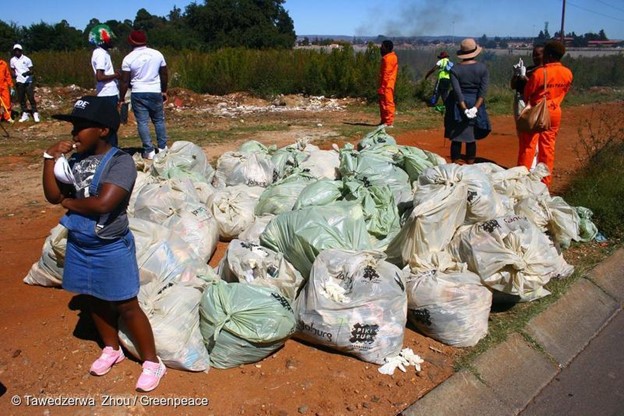
13 April 2021 - Greenpeace Africa and Break Free From Plastic are urging South Africans to join thousands of others in commenting on new regulations to address the nation’s plastic pollution crisis.
The anti-single-use plastic coalition is calling for the Department of Environment, Forestry and Fisheries (DEFF) Director-General Anben Pillay to adopt stricter measures to cut down production of single-use plastic on top of amendments already proposed. Over the weekend, 2,000 people have made submissions to the department via the coalition’s online form, which lets people send emails directly to the department.
"Plastic is a threat to our health. Research repeatedly shows the health of the environment is closely linked to human health. In the context of the current pandemic, it has never been more important to put in place measures to prevent further threats to our safety," said Greenpeace Africa Pan-African Plastic Project Lead, Angelo Louw.
Ikwezi Coal Mine Protest: Three activists arrested during protest to appear in court.
Three of the eight activists arrested during a peaceful protest against a coal mine in Dannhauser, KwaZulu-Natal appear in court.
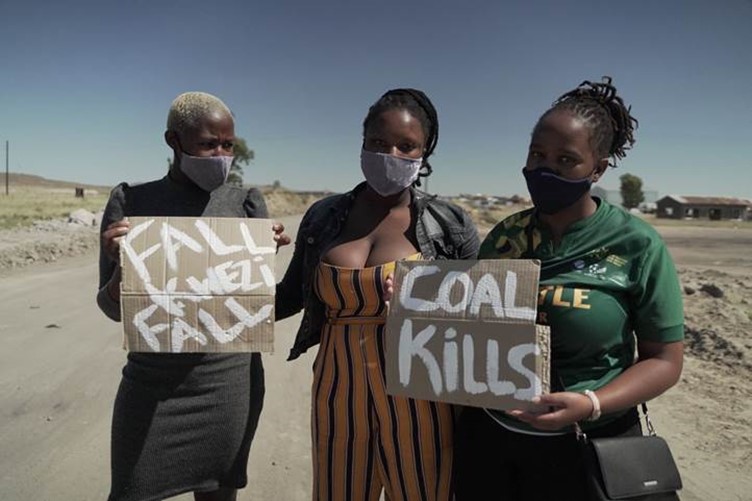
Sindi Kubheka (24), Zanele Kubheka (21), and Buhle Kunene (24) outside the Ikwezi mine where they were arrested during a peaceful protest last month. Image: Jasmine Sarwoko.
12 April 2021 - Three activists arrested during a protest against Ikwezi coal mine in Dannhauser will today appear in court. The three women were part of a two-day protest which took place on the 11th and 12th of March 2021 against the Ikwezi Coal Mine. Sindi Kubheka, Zanele Kubheka, Buhle Kunene were amongst the eight activists arrested after police fired rubber bullets at a group of protesters.
The police shot at community people seeking to peacefully engage with the Ikwezi Coal mine management on the 12th March 2021. This was on the second day of a two-day protest by community members. The community is affected by the Kliprand Colliery owned by Ikwezi coal mine.
Four activists were injured during the incident and they have since laid charges of assault and illegal arrest against the police. This after police fired rubber bullets at peaceful protesters, and activist Thoko Nkosi was apprehended and arrested by Ikwezi mine security. Nkosi was later released on the same day as her arrest was deemed improper and illegal.
Global Day of Action: A Call for Leaders to Go Beyond Recovery to a Zero Waste Future
Zero Waste Proven Strategy for COVID-19 Economic Recovery: Mitigating Climate Change, Creating Good Jobs, and Revitalizing Local Economies
31 March 2021- Environmental Justice groups around the world are joining a Global Day of Action to demand that our leaders go beyond recovery, to a future where zero waste practices drive clean air and water, more and better jobs, and a healthy environment for our families and communities, as our planet returns to a life-sustaining pathway where nothing and no one is wasted.
Over 150 groups across the globe have organized actions [50 events in 18 countries], signed petitions, or taken to social media to unite around a common blueprint for leaders to build a better future beyond COVID-19.
Reprieve for Mpumalanga Strategic Water Source Area as Court halts start of new coal mine
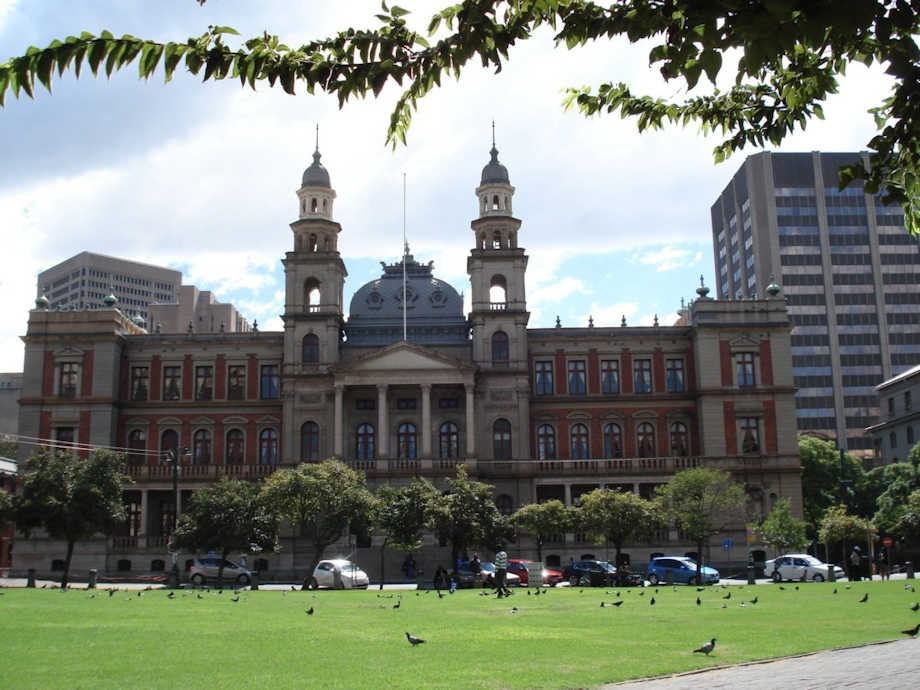
The North Gauteng High Court in Pretoria
24 MARCH 2021 - Yesterday, March 23rd, the North Gauteng High Court issued an interdict preventing a coal mining company from commencing mining and related activities in a Strategic Water Source Area. The interdict was issued to allow the legal challenges of its various permits to be decided first – before harm is done to strategic and important water sources.
The High Court’s order prevents and restrains coal miner Uthaka Energy from conducting any mining activities and mining-related operations (including any activities preparatory, ancillary or incidental to mining) – save for survey pegging of the surface infrastructure boundary and wetlands demarcation pegging of the approved plan – in respect of its proposed Yzermyn coal mine near Wakkerstroom, Mpumalanga.
The proposed coal mine would fall within a Strategic Water Source Area – one of only 22 areas where more than 50% of South Africa’s freshwater originates. Protecting strategic water source areas is crucial for South Africa’s water security, and for their ability to provide water for people and our country’s economic activity.
Community activists protesting devastating impacts of coal mine shot at and arrested
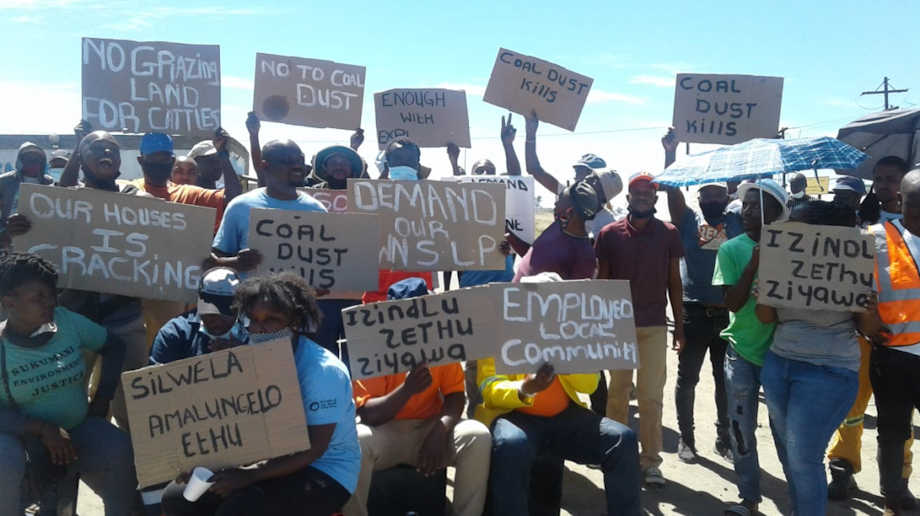
Community activists protesting outside Ikwezi Coal mine on 11 March 2021
17 March 2021 - In Dannhauser, the activists were protesting against the Ikwezi Coal Mine’s impacts on the community, their property and their livestock. The continuous blasting by the mine emits heavy black smoke that is not only debilitating to the community’s general wellbeing, but also places them at greater risk of respiratory illnesses. The blasting has also cracked some community members’ houses, and there is fear that some of the houses will not be able to withstand the continuous blasting.
Community members also contend that they are losing livestock because they are grazing on grass covered with black coal dust, and they think that mine waste may have contaminated some of the local water sources.
“The experiences of the community next to which Ikwezi operates its coal mine are standard for so many mining communities across the Mpumalanga Highveld,” says Robby Mokgalaka, community coal campaigner from environmental justice group groundWork. “Mining companies arrive with many promises, but it is those communities that then face devastation to their lives and livelihoods, without sharing in any of the profits.”
Participants in the two-day protest outside Ikwezi’s coal mine were unarmed and non-violent, and were not trespassing on any property. Yet while community representatives were negotiating with mine officials during the second day of protest for a suitable meeting venue to discuss the community’s grievances, police opened fire on the group when they refused to disperse. Various activists suffered injuries.
According to the protestors, Mr Bonani Ndlovu, a director of Ikwezi, was present during the shooting and arrest of the activists.
Occurrences like these are not unique to the Dannhauser community. In April 2019, the Centre for Environmental Rights together with groundWork, Human Rights Watch and EarthJustice released a report titled: “We Know Our Lives Are in Danger’: Environment of Fear in South Africa’s Mining-Affected Communities”. This report reveals that the South African Police Service frequently use violence and arbitrary arrests, in concert with mining companies and their security firms, to silence the voices of community activists raising legitimate complaints about mines and their operations next to their homes. Communities living adjacent to mining operations pay an unacknowledged price for these operations with their health, wellbeing and livelihoods.
The Constitutional right to protest peacefully and unarmed continues to be unreasonably violated by the South African Police Services. It is unacceptable for the police to use violence and unlawful arrests against the community members who are merely trying to protest to assert their rights for a better life. However, exercising the right to protest is increasingly becoming a risk and danger to activists’ freedom and to life.
“Condemning the acts of members of the South African Police is no longer enough: we need tangible interventions from government to reform how police view and respond to peaceful protest,” says Matome Kapa, attorney and head of the Activist Support & Training programme at the Centre for Environmental Rights.
groundWork Releases State of Environmental Justice Report 2020 - “The Elites Don’t Care”: People on the frontlines of Coal, Covid, and the Climate Crisis
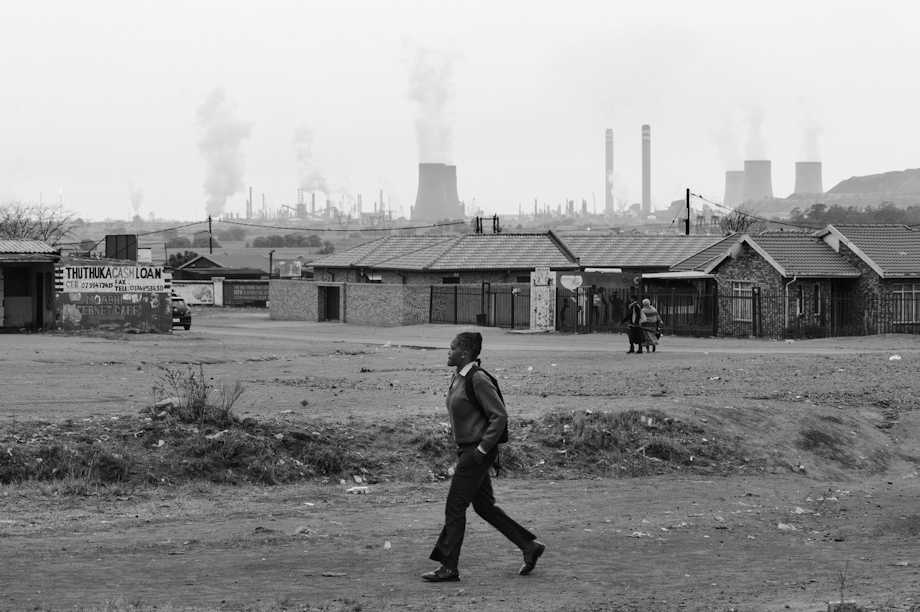
Image: Daylin Paul
17 March 2021 - Environmental Justice organisation groundWork will today launch their latest report on the state of environmental justice in South Africa titled The Elites Don’t Care: People on the frontlines of Coal, Covid, and the Climate Crisis.
This report follows on from Down to Zero, the groundWork 2019 report on the politics of an (un)just transition. It looks at the impacts of the pandemic from global to local level, in particular reporting on the research of community activists in each of South Africa’s active coal fields. It also examines government’s actual climate response, as it bets on a fossil gas bonanza to deliver economic redemption and still punts the so called clean coal, even as Eskom abandons that myth.
The climate crisis is part of the broader ecological crisis created by global capitalism and its devotion to profit and growth. The Covid crisis emerges from the rent in the web of life and, while climate change is a slow motion wreck, the impact of Covid is synchronised across the world and compressed into weeks, months and a year or two. It does not merely foreshadow climate change. It is an instance of the disruptions that follow from wide scale ecological disturbance – including climate change. And the baleful fires of the pandemic have illuminated and widened the fault lines of the global economy – exposing rank inequality, poverty and hunger.
At the report launch, community activists from different coal struggles across the country will share their research of experience in the coal frontlines during a deadly pandemic. From people in the Mpumalanga Highveld where breathing clean air is a daily struggle, to Ermelo where mines are abandoned post extraction and land is left without any efforts to rehabilitate, to northern KwaZulu-Natal where livelihoods are destroyed through forced removals and extreme violence against those who resist. Given the experience of Covid, what should people expect from government as the climate crisis intensifies?
Divide to Conquer: Some activists released unconditionally and only women activists to appear in court on 12 April 2021.
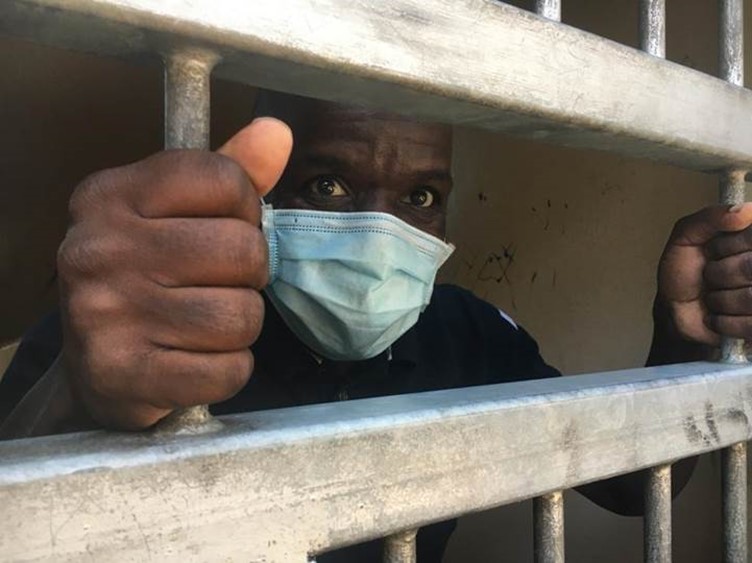
groundWork's coal campaigner Robby Mokgalaka in custody at the Dannhauser police station
15 March 2021 - Eight environmental justice activists who were arrested on Friday 12 March 2021 during a protest against Ikwezi Coal Mine in Dannhauser have been released. Robby Mokgalaka, Zakhele Mthanti, Isaac Shabalala, Sipho Shabalala, and Themba Khumalo have been released with no charge. Only women activists, Sindi Kubheka, Zanele Kubheka, Buhle Kunene, have been released on bail and will again appear in Dannhauser magistrate court on the 12th of April.
This appears to be an old apartheid tactic of divide to conquer, as all the activists were part of the protest against the mine and its impacts on the community and the environment. About 40 fellow activists and supporters gathered and picketed outside the Dannhauser magistrate court and demanded the unconditional release of their comrades.
The activists are expected to lay charges of assault and illegal arrest against the police. This after police fired rubber bullets at peaceful protesters, and activist Thoko Nkosi was apprehended and arrested by Mine security. Nkosi was later released on Friday. The picket is also expected to be taken to Dannhauser police station where the eight were detained in police cells since Friday.
See our previous news item on the arrest of the activists here.
Contacts:
Nkanyiso Mthombeni
+27 82 073 8550
thandolempisi@gmail.com
Tsepang Molefe
+27 74 405 1257
media@groundwork.org.za
Again, Blacks are Vulnerable Targets of Police Brutality
Eight activists arrested during a mine protest to appear in court for a bail hearing
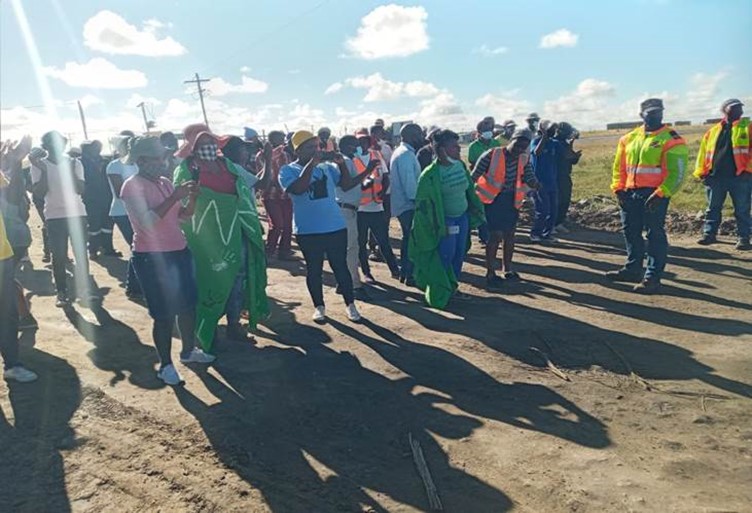
Activists and community members protest Ikwezi Coal Mine in Dannhauser
15 March 2021 - Eight of the nine activists arrested during a protest against Ikwezi coal mine on Friday, will today appear before the Magistrate Court in Dannhauser. Sindi Kubheka, Robby Mokgalaka, Themba Khumalo, Isaac Shabalala, Zakhele Mthanti, Zanele Kubheka, Buhle Kunene and Sipho Shabalala will all stand before the Court for a bail hearing.
The eight were part of a two-day protest where police fired rubber bullets, one activists sustained serious injuries others sustained just minor injuries and nine were taken into custody. The protest by community members and activists started on Thursday and on Friday, the second day of protest the people were confronted by police.
It is not clear why police decided to fire rubber bullets as this was a peaceful protest and this horrible incident took place while community representatives and mine personnel were busy in talks for a suitable venue to engage with the protesters. The protesters were not armed, did not show any signs of violent behavior, nor were they trespassing. And the law clearly states that, police use approved rubber rounds to disperse crowds only in extreme circumstances, if less forceful methods have proven ineffective.
“What happened in Dannhauser cannot be viewed in isolation from the incident that claimed the life of a bystander Mthokozisi Ntumba in Braamfontein during a student protest. The police brutality that we keep witnessing is a serious threat to our democracy and the rights of people to protest and express their concerns and views. While police misconduct and brutality is not acceptable in any way or form, this senseless behaviour seems to be directed or targeted at a specific racial group – blacks”, says Bobby Peek from environmental justice group groundWork.
One activist, Thoko Nkosi was later released on Friday after it was established that she had not been apprehended by the police but by the mine security guards. Local activists will stage a picket outside the Dannhauser magistrate court tomorrow morning calling for the unconditional release of those arrested.
NEWSFLASH - Dannhauser Ikwezi Mine Protest: Nine Activists Arrested
12 March 2021 - Just two days after bystander Mthokozisi Ntumba was killed when police opened fire on student protesters in Braamfontein, activists in KZN protesting peacefully against the Ikwezi mine were confronted by excessive force from SAPS members.
Nine environmental activists have been taken into police custody in Dannhauser, KwaZulu Natal. They were charged with 1) contravening a court order; 2) public violence; and 3) assault of a police officer. The nine were part of a group peacefully protesting against the Ikwezi coal mine. Eight were finally charged and held in custody until a court appearance on Monday, 15th March 2021.
The planned two-day protest started on Thursday morning and the group continued their peaceful protest into Friday when they were confronted by police. While community representatives were busy negotiating with the mine personnel, police fired rubber bullets at the group who were peacefully demonstrating. The police also used force to pin down and arrest the activists, among them four women, who were part of the protest.
Sindi Kubheka, Robby Mokgalaka, Themba Khumalo, Isaac Shabalala, Zakhele Mthanti, Zanele Kubheka, Buhle Kunene and Sipho Shabalala are all behind bars at the Dannhauser police station. The protesters, including the nine arrested, did not damage any property, were not trespassing, nor were they in any way violent during the protest.
It is clear that the South African Police Services do not understand how to undertake public safety policing and violence is their only response. At the protest the police made use of excessive force when it was not necessary. They abused their powers and denied affected community activists their right to protest and their voices to be heard. The unnecessary use of force and arrest on black protesters in this country is a continuing trend.
This abuse by police and the failure of government to act to protect people has been documented in a 2019 report by Human Rights Watch, which focused on the impact of mining on people in South Africa. This report called on the Department of Police, including the National and Provincial Commissioners, to:
- Ensure that law enforcement authorities respect and protect the right to protest, including by not using unlawful measures of crowd control beyond what is strictly necessary to prevent harm to people or excessive harm to property; and
- Ensure that community rights defenders and others opposing mines are not arbitrarily arrested or detained, including by complying with of the Constitutional Court's decision prohibiting the arrest and criminal prosecution of conveners for failing to give notice of a protest to municipalities.
This report also warned of the violence in Somkhele which sadly led to the murder of MamFikile Nshangase.
Today it was clear that the police were pre-empting the situation and came to the second day of the protest in armored vehicles. The community fearing violence decided to sit down, but still the police used violence against them after a rock was allegedly thrown at the police.
At the Dannhauser police station and Magistrate's Court, the police delayed in processing the charges and as a result bail could not be granted, which means the activists will spend the entire weekend in jail.
For contact details to obtain further information please click here.
Enough is enough: Communities in Newcastle Protest Ikwezi Coal Mine
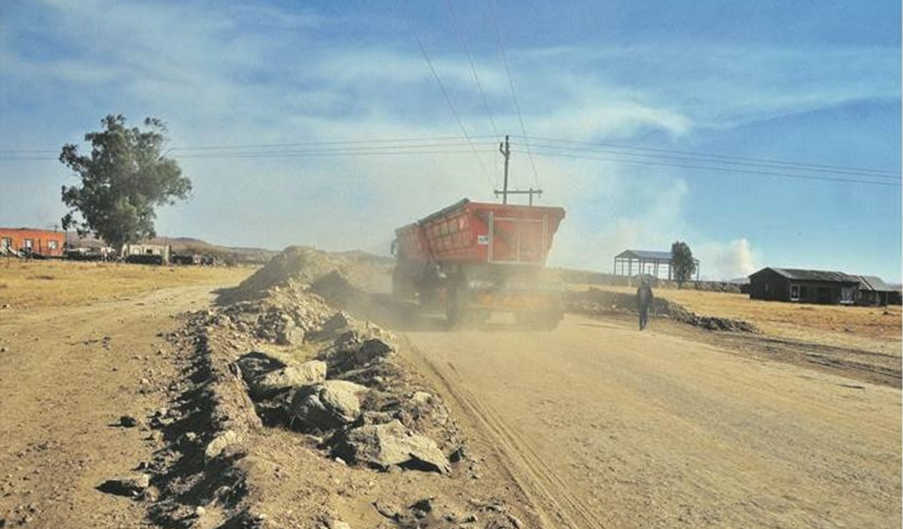
A coal truck passes through a village in Dannhauser, Newcastle. Photo: News24
11 March 2021 - The mining affected communities in Newcastle are protesting on Thursday and Friday, 11-12 March 2021. The communities of Kliprand farm, Cloneen, Kàlvlakte, Jan Farm and Dragan Farm of Dannhauser in Newcastle, KwaZulu-Natal Province, are protesting against the Ikwezi Coal Mine about its Kliprand colliery which has continuously refused to take responsibility for the impacts from its mining operations. The Australian company which operates an opencast coal mine in the area is accused of abusing and bullying communities.
The community is mainly concerned with the following:
- People’s health is being affected at Kliprand Farm by coal dust caused by the mine and trucks.
- Blasting at the mine is damaging houses.
- There is no open democracy as the Social Labour Plan (SLP) is not a public document and does not serve the needs of local people.
- The mine brings no benefit to local people as labour is outsourced.
- Community livestock are dying in numbers because they are grazing grass covered with coal dust.
- The mine management refuses to engage with community members.
This two-day protest was preceded by a protest which took place last December and where the community handed over a memorandum to mine management. All the issues raised in that protest are yet to be resolved and there has not been any engagement with the community.
“Enough is enough, we’re not going back to the regime where mines exploited our resources, destroyed our land and left us dumps, contaminated water and sick people. Ikwezi mine must take responsibility for their harm on our well-being and the environment.” Themba Khumalo, Secretary of Sukumani Environmental Justice
"The problem with our system is that corporates are allowed to do as they please. Mining companies violate the rights of the poor with impunity because they are bigger than the law.” Robby Mokgalaka, groundWork’s coal campaigner.
On 01 June, 2018, the Department of Mineral Resources suspended Ikwezi Mine's license owing to its unlawful failure to comply with the social and labour plan despite having had the mining rights for six years, and how the mine transgressed the approved environmental management programme by tampering with graves.
Contact details and links to further information are avaiable here.
Deadly Air Case Update: Pollution-trapped Highveld communities “need more than sympathy”
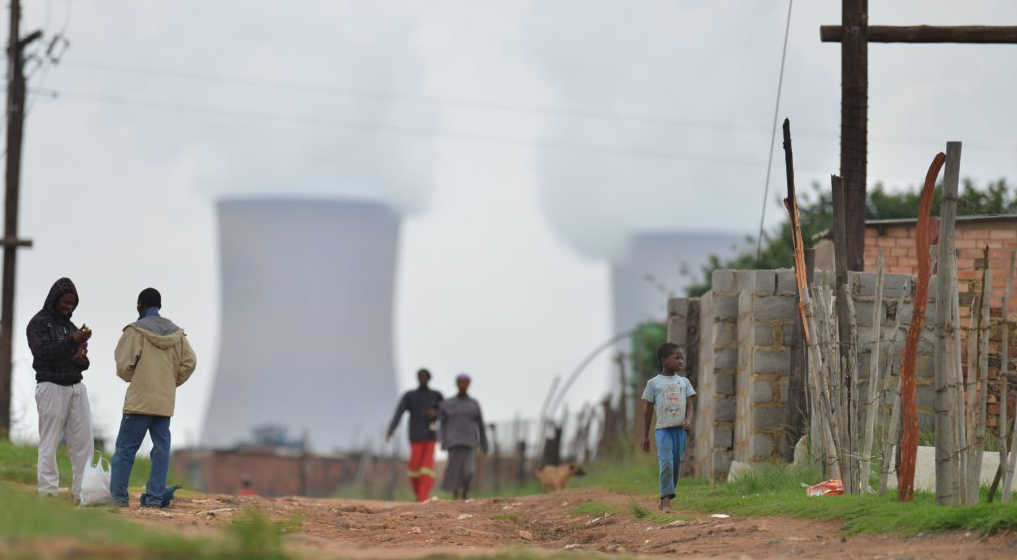
Image: © Mujahid Safodien / Greenpeace
06 March 2021 - Environmental justice groups groundWork and the Vukani Environmental Justice Movement in Action (VEJMA) have responded to papers filed by the Minister of Environment Forestry and Fisheries in the “Deadly Air” court case against government about the toxic and unsafe levels of air pollution that people living and working on the Mpumalanga Highveld are exposed to daily.
In her affidavit filed on behalf of all the government respondents, Minister Creecy denies that government is failing in its obligations to address the air pollution in the Mpumalanga Highveld, where 12 of Eskom’s coal-fired power stations, Sasol’s Secunda coal-to-liquids plant, significant coal mining operations, and other heavy industries are based. The mining, transport and burning of coal are responsible for the overwhelming majority of outdoor ambient air pollution in the Highveld.
Responding to Minister Creecy in her affidavit expressing sympathy for people living and working in the Highveld Priority Area, groundWork’s Thomas Mnguni, also a Highveld resident and a concerned parent, says in his affidavit: “It is not the Minister’s sympathy that we need, but rather the urgent and proper implementation and enforcement of air quality laws in a manner that protects our health. It does not help for government officials to tell pollution-trapped communities that they care, they need to show us through their actions. Responsible government officials must be accountable.”
groundWork and VEJMA are asking the court to declare that the poor ambient air quality in the Highveld Priority Area constitutes a violation of the Constitutional right to an environment not harmful to health or well-being, as clearly outlined in Section 24 of the Constitution. They are also asking the court to order the government to take further steps to improve the air quality in the area. The applicants are represented by attorneys at the Centre for Environmental Rights.
On International Waste Pickers’ Day, Report Shows that Cities that Partner with Informal Recyclers Create Good Jobs, Help the Climate, and Save Money
Working with Waste Pickers is Essential to an Inclusive Economic Recovery
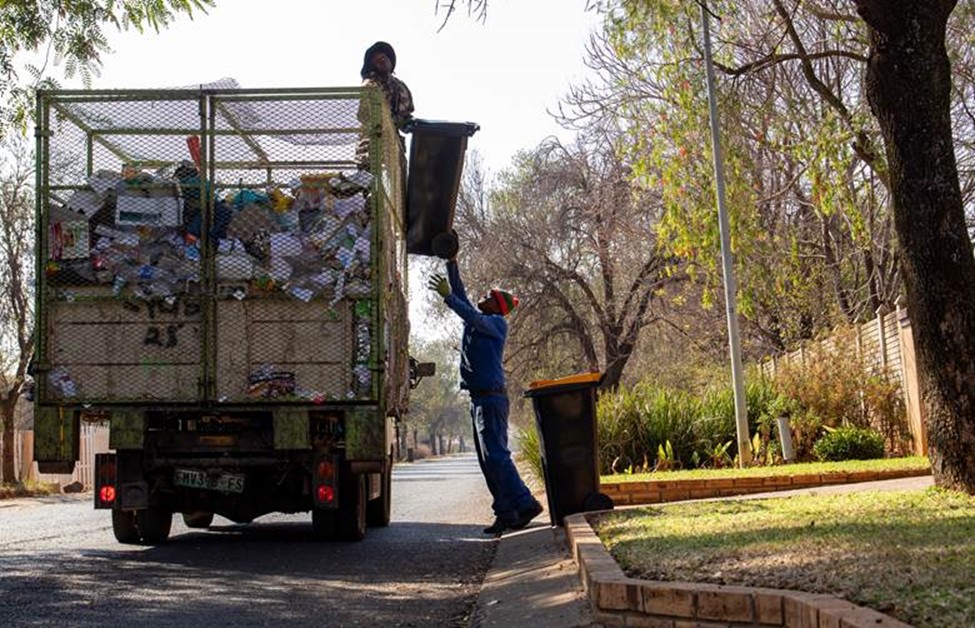
SAWPA members conducting door to door waste collection in Vaal Park, South Africa. Photo Credit: Focalize Media
01 March 2021 - The COVID-19 pandemic has brought about devastating economic turmoil across the globe. Consequently, the agendas of many governments are currently centered on economic recovery, job creation, and poverty alleviation. A new report by the Global Alliance for Incinerator Alternatives (GAIA), shows how government investment into zero waste systems presents an opportunity for economic recovery and social justice.
The report highlights that through forging partnerships with informal recyclers using dedicated economic recovery funds, governments can make a transition to zero waste city systems. Based on research from countries in the global south such as South Africa, Brazil, India, and China, this report finds that inclusive zero-waste cities have led to greater economic justice for people doing essential work, cost-saving for cities and better environmental outcomes.
It also uncovers the extent to which informal recyclers have become the cornerstone of recycling in Global South cities. Statistics show that in South Africa, waste pickers recover between 80 to 90% of the post-consumption packaging and paper. In Brazil, the National Waste Pickers Movement (MNCR) is responsible for collecting 90% of all material recycled in the country. Moreover, in India it is estimated that waste pickers recycle 54% of all recycled glass, 34-45% of all recycled plastic, and 28-50% of all recycled cardboard and mixed paper.
Chasing Carbon Unicorns: The deception of carbon markets and "net zero"
22 February 2021 - Powerful actors are using “net zero” pledges to hide their climate inaction. Stopping the climate crisis requires us to stop burning fossil fuels – no magical thinking will solve this problem, just immediate action and system change. But transnational corporations and governments are hiding behind the “net” in “net zero” – claiming that they just need to pay someone else to remove carbon, through carbon offsetting, rather than taking action on their own.
This report unpacks the science behind “net zero” claims and how they are used to obscure climate inaction. It explores the new strategies to expand carbon offset markets, linked with new “net zero” demand for offsets. It also explains the roles played by various actors involved in the effort to “make offsetting great again”. These include less obvious players such as a few large mainstream conservation organisations, as well as the more obvious ones: the banks, the finance industry, and corporate interests behind maintaining the status quo of fossil fuel production and consumption.
“Net zero” means that fossil fuel companies can continue to explore, drill, extract, and burn fossil fuels, while someone somewhere else sucks carbon dioxide out of the atmosphere, magically balancing out emissions. But whose land, whose forests will be used to suck that carbon out? Fossil futures require carbon unicorns.
The area of land required to sequester just 2 Gt CO2 through ecosystem restoration is estimated at 678 million hectares – about twice the land area of the country of India. Communities in the global south are already facing huge land and resource grabs, loss of livelihoods, and violations of their territorial rights.
“Net zero” targets need to be transformed into Real Zero targets, including a complete phase-out of fossil fuels and industrial agriculture, keeping equity in mind, and support for rights for communities whose livelihoods are dependent on those ecosystems.
Gauteng residents given a whiff of Mpumalanga Highveld pollution
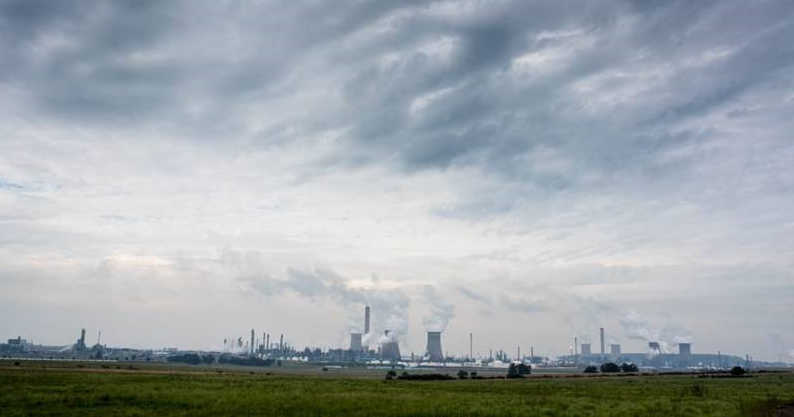
Image by: Daylin Paul
18 February 2021 - Over the past few days, unusual and persistent levels of sulphurous smells in the air have given residents of Gauteng a glimpse of what life is like for people who live in some of our country’s most polluted places on the Mpumalanga Highveld – one of the South Africa’s worst air pollution hotspots.
On Saturday, 13 February 2021, Gauteng Weather started reporting on the strong sulphur smell in Gauteng, and noted that southeasterly winds pointed in the direction of Mpumalanga as the source. Many residents of Gauteng noted complaints of breathing problems, burning eyes, blocked noses and bad chests on social media.
According to air quality expert Lauri Myllyvirta, lead analyst at the Centre for Research on Energy and Clean Air, the rotten egg smell is a strong indicator that the pollutant in question is hydrogen sulphide, or H2S.
Sasol’s Synfuels facility in Secunda, Mpumalanga, is the main source of H2S in Mpumalanga.
SAHRC Releases Final Report of the Gauteng Provincial Inquiry into the Sewage Problem of the Vaal River
17 February 2021 - The South African Human Rights Commission has today released its investigative report on the contamination of the Vaal River.
Samson Mokoena, the Vaal Environmental Justice Alliance (VEJA) Coordinator, commented on the report as follow:
As VEJA we welcome the report, it confirms the issues we have been raising especially relating to section 24 of the constitution. The report confirms that the South African government has violated our rights. The state has not taken any action to solve this issue, and the report has confirmed today that law and regulation enforcement mechanisms are failing. By allowing sewage to flow in the Vaal River the government is also going against its international obligations as per UN assembly resolution of 2010, that water is a human right, the report was able to highlight that. The contamination of the Vaal River negatively impacts the environment, the well-being and also dignity of our people.
New Study: Zero Waste Systems Could Create Thousands of Jobs for Durban Residents
Zero Waste Found to Be a Key Strategy to Build Strong, Sustainable Economies Post-COVID-19
16 February 2021 - A new study from GAIA finds that cities that invest in zero waste programs and policies create good green jobs, in addition to known benefits of reducing pollution and improving community health. This report comes as municipal governments worldwide are making critical decisions about which programs to invest in to increase climate resilience and rebuild local economies that have been damaged by the COVID-19 crisis. The study projects that if Durban were to recover 80% of recyclable and organic material in its waste stream, the city could create over 4,000 new jobs.
Read the full media release and get the report here.
Statement on environmental MEC’s decision to exclude properties from the Mabola Protected Environment to enable a new coal mine
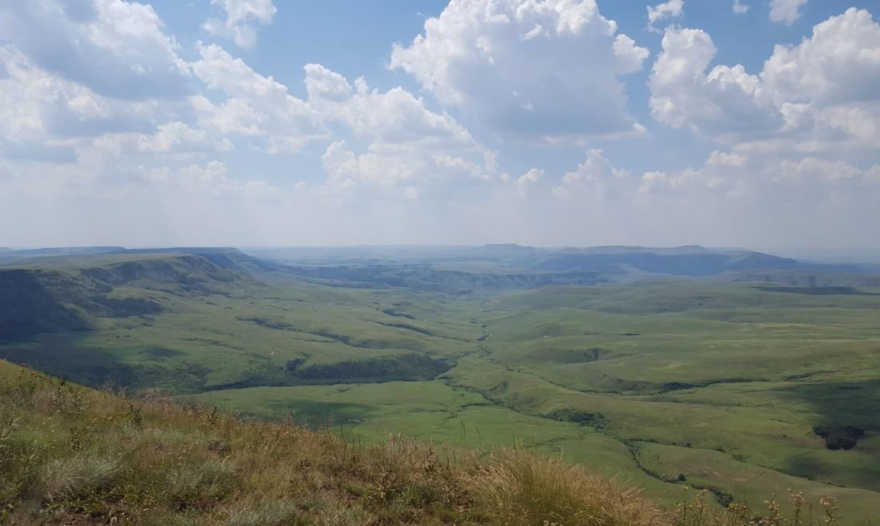
15 February 2021 - We, a coalition of eight non-profit public interest organisations, have been challenging the authorisation of a large new coal mine inside a declared Protected Area and Strategic Water Source Area in Mpumalanga since 2015.
We condemn the recent decision by MEC VR Shongwe, the Mpumalanga MEC for Agriculture, Rural Development, Land and Environmental Affairs, to revoke the protected area status for a large part of the Mabola Protected Environment in order to enable that new coal mine to proceed.
Supreme Court of Appeal Ruling on Tendele to be Appealed in Constitutional Court
15 February 2021 - On Tuesday, 9 February 2021, the Supreme Court of Appeal, in a majority decision, dismissed an appeal calling for Tendele coal mine to comply with environmental legislation. The case raises an important point of law where there is currently uncertainty leaving loopholes that require a legal precedent to bring clarity.
Kirsten Youens, the Attorney for the Global Environmental Trust (GET) and Mfolozi Community Environmental Justice Organisation (MCEJO), described the majority judgement as “focussed on procedure over justice that does not deal with the issues, whereas the dissenting judgement by Shippers JA is excellent and exactly what we need to take the matter on appeal to the Constitutional Court.”
Advocates Thembeka Ngcukaitobi and Mawande Mazibuko acted for the appellants in the SCA case. They consider the matter too important to environmental law jurisprudence for it to be decided purely on procedural law. They are already preparing to take the case to the Constitutional Court. This course of action appears to have the support of Judge Shippers whose judgement emphasizes protection of the natural environment, as in this reference to the Fuel Retailers case, where the Constitutional Court states:
"The role of the courts is especially important in the context of the protection of the environment and giving effect to the principle of sustainable development. The importance of the protection of the environment cannot be gainsaid. Its protection is vital to the enjoyment of the other rights contained in the Bill of Rights; indeed, it is vital to life itself."
The Tendele open cast coal mine is situated on the border of Hluhluwe-iMfolozi Game Park, Africa’s oldest proclaimed nature reserve with the highest density of white rhino in the world. The appeal was brought by GET, a not-for-profit organisation established to preserve biodiversity and protect natural resources, and by MCEJO, a community-based organisation that supports the implementation of environmentally sustainable projects for communities living along the Mfolozi river in northern KwaZulu-Natal (KZN). The application was supported by thousands of MCEJO members from neighbouring local communities.
SAHRC vs uMsunduzi: Municipality in High Court for failing to clean up
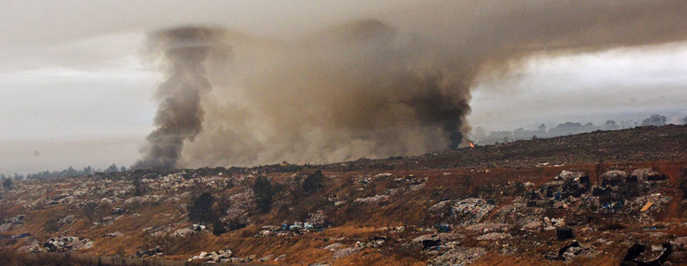
15 February 2021 - The case filed by the SA Human Rights Commission (SAHRC) against the uMsunduzi municipality over its management of the New England Road Landfill site in Pietermaritzburg is being heard in the high court today.
The case was filed in the high court by the SAHRC after its investigation on the matter, and consultations with different stakeholders including, groundWork, Ratepayers Association, Save PMB, affected communities and residents. Post its investigations the SAHRC red-flagged the state of the site and its impact on the environment and on public health.
The landfill is known for its fires that flame for days, and engulf the city with smoke, forcing schools to shut down and some residents to evacuate their homes due to the toxic smoke. In April last year the fires went on for more than three days. The SAHRC subsequently received a number of complaints from Pietermaritzburg residents, and a protest was held near the site with a petition against the dump which was also handed over to the commission.
Coalition condemns MEC’s decision to revoke protected area to allow new coal mine
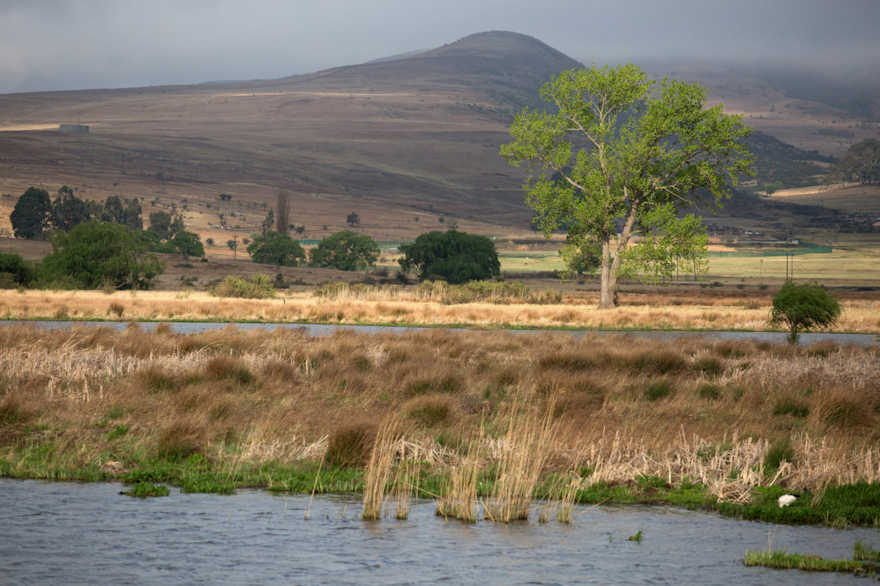
Water heritage under threat Mabola Protected Environment, Wakkerstroom, Mpumalanga, faces potentially catastrophic threats from a new coal mine. One of only 22 Strategic Water Source Areas in the country, it is composed mostly of wetlands, pans and endangered grassland ecosystems that support endangered species and the provision of clean water. The mine is set to cause irreversible damage to the sensitive and critically important aquatic environment. Picture: JAMES OATWAY for CER.
11 February 2021 - Last month, the Mpumalanga Provincial MEC for Agriculture, Rural Development, Land and Environmental Affairs, MEC VR Shongwe, published his decision to revoke the protected area status for a large part of the Mabola Protected Environment in Mpumalanga in order to enable a controversial new coal mine to proceed.
The Coalition of eight public interest organisations who have, since 2015, been challenging the development of that proposed new coal mine, have condemned the MEC’s decision. The proposed mine would also fall inside a Strategic Water Source Area.
The MEC’s decision comes after the Coalition successfully challenged in court the permission previously given for the mine by the former Ministers of Environmental Affairs and Minerals, the late Edna Molewa and Mosebenzi Zwane.
The Coalition’s court challenge resulted in the High Court setting aside those permissions as unlawful and awarding punitive costs against the MEC and the Ministers. The court found that there was no justification for their lack of transparency, and departure from procedures required by law. Four attempts by the mining company to challenge the High Court decision failed, with a full bench of the High Court, the Supreme Court of Appeal (SCA), the President of the SCA, and ultimately the Constitutional Court, leaving the Coalition’s judgment intact.
Now, in an apparent attempt to circumvent those judgments and the Protected Areas Act itself, the MEC has revoked protection for a large portion of the protected environment to push through a new coal mine inside Mabola.
141 NGOs Call for a Moratorium on Large-Scale Mining and Oil and Gas Extraction in Greenland
10 February 2021 - In an appeal published today, 141 NGOs from all over the world call on the Greenlandic and Danish governments and the European Union to help protect the Greenlandic and Arctic environment. Greenland possesses some of the world’s largest oil and gas and mineral reserves. Thus far, there are about 70 active large-scale exploration and exploitation licenses in Greenland, covering thousands of square kilometres. Almost all are surface mining projects, often at high altitude.
The 141 NGOs call on the Greenlandic and Danish governments, the European Union, and everybody else who take an interest, to help establish an Arctic sanctuary. The inspiration could be the Antarctic Treaty, as supplemented by the Madrid Protocol signed in 1991, but respecting the fundamental difference represented by the populated nature of Greenland and the Arctic and the rights and needs of the peoples and nations of the Arctic region.
Fossil fuel air pollution responsible for 1 in 5 deaths worldwide – major study
Deaths from fossil fuel emissions higher than previously thought
09 February 2021 - More than 8 million people died in 2018 from fossil fuel pollution, significantly higher than previous research suggested, meaning that air pollution from burning fossil fuels like coal and diesel was responsible for about 1 in 5 deaths worldwide, according to new research from Harvard University, in collaboration with the University of Birmingham, the University of Leicester and University College London.
Regions with the highest concentrations of fossil fuel-related air pollution — including Eastern North America, Europe, and South-East Asia — have the highest rates of mortality, according to the study published in the journal Environmental Research.
The study greatly increases estimates of the numbers killed by air pollution. The most recent Global Burden of Disease Study, the largest and most comprehensive study on the causes of global mortality, put the total number of global deaths from all outdoor airborne particulate matter — including dust and smoke from wildfires and agricultural burns — at 4.2 million.
Read the full media release and find links to the report here.
Resist Nuclear Procurement!
05 February 2021 - In December 2020, energy Minister Gwede Mantashe issued a determination to commence the process to procure the new nuclear energy generation capacity of 2 500 MW as per decision 8 of the Integrated Resource Plan (IRP) 2019.
This is a folly in groundWork's view, not only a piece of foolishness, but an extravagance built for appearance or status. groundWork has today submitted comment to the National Energy Regulator (Nersa) setting out our reasons for opposing any new nuclear construction. They include: the environmental destruction done in the mining and processing of uranium and in the energy intensive fuel fabrication process; the lack of any feasible plan to deal with high level nuclear waste; the exorbitant cost of the nuclear build and again of decommissioning at the end of the plant's life; the high likelihood of cost and time overruns; the scope for corruption and/or geo-political leverage by national peddlers of nuclear power; the anti-democratic requirements for secrecy and high level security.
The activists who are greening Wesselton
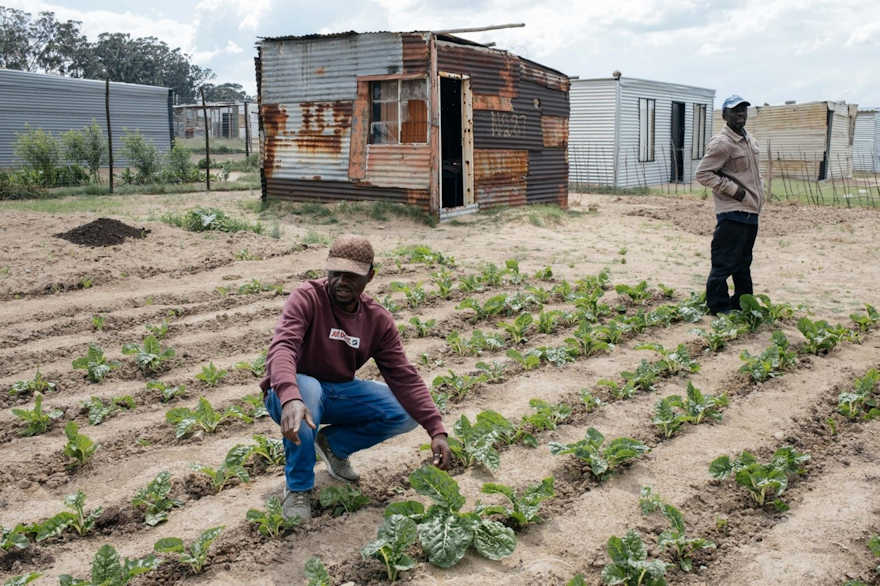
26 November 2020: From left, Linda Magagula and Simon Nkosi tend to a crop of spinach on Magagula's plot in the Nomzamo agricultural village in Wesselton. Nomzamo was established on a portion of the unrehabilitated Imbabala coal mine. Photo: James Puttick.
01 February 2021 - Residents of this township in one of Mpumalanga's coal-mining districts have been benefitting from grassroots initiatives to turn ugly dumping sites into precious green spaces.
For 20 years now, the members of the Khuthala Environmental Care Group in Wesselton, Ermelo, have tried to address the persistent environmental damage left by the coal mines as well as residents who dump their garbage irresponsibly. In doing so, they have transformed what would have been toxic spaces into sites of pride and beauty.
The group's passion for a greener future has led to giant gains for Wesselton township, which is hemmed in by abandoned and unrehabilitated coal mines.
New Year Message from groundWork Director, Bobby Peek.
 How does one approach 2021? Writing about our fears or predictions? Or seeking hope? I finally settled on the latter. I am not qualified to make predictions; there are many out there who are more informed. But like millions of others who want a more sustainable existence with the earth, I am hopeful that ongoing activism worldwide can slowly chip away at the chains of power and greed.
As Pablo Solón, Bolivian activist and ex-diplomat, put it, “2020 wasn’t the worst year, it was just one of the beginnings of the systemic crisis. Hope is not in the year that begins but, in our ability, to change and subvert the ‘normality’ that brought us here. The year 2020 brought to the fore with clarity the reality that system change is needed". Like Solón, my hope lies in our ability to change and subvert the old normal, and start creating a new normal, and we do this first by stopping the foolishness of the past, and through this, create the justice for the future.
